
The scale says you’re winning. But are you losing the right weight?
Medically reviewed by Christina Warner, APN-C. Updated Sep 7, 2026.
Not necessarily. Weight lost during GLP-1 therapy does include some lean mass, averaging about 29 percent of total weight lost across DXA-based reports. But lean mass is not the same thing as muscle, and a lower lean-mass number does not by itself show that strength or physical function declined. The better question is what improved, what was preserved, and what needs attention next.
Why the number on the scale is real but incomplete
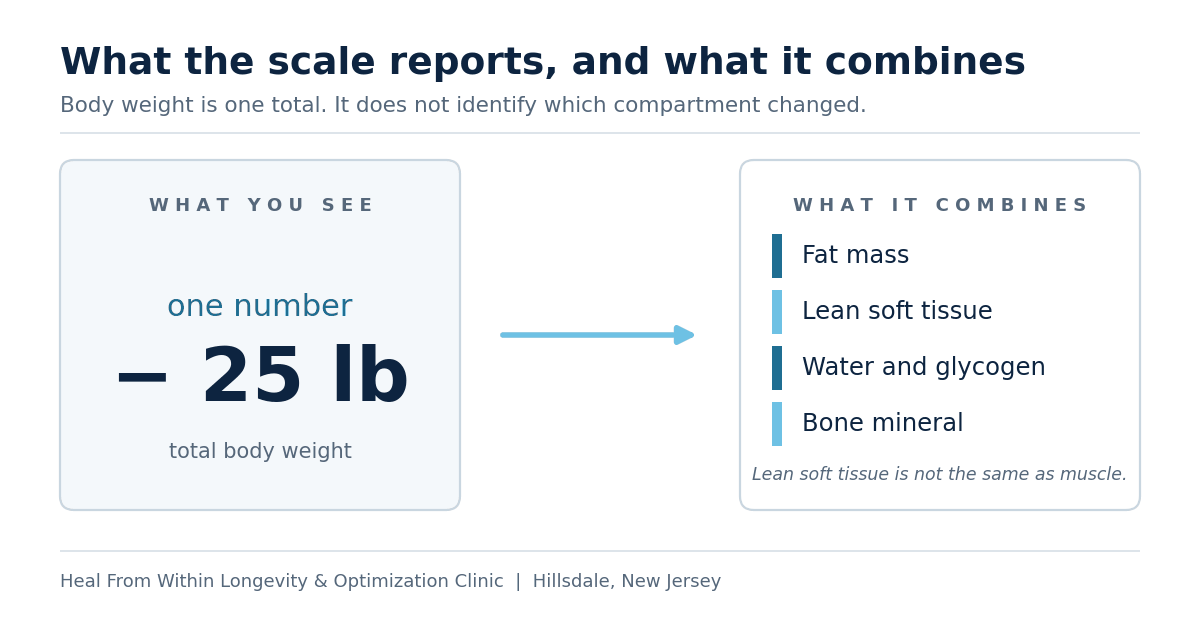
When someone loses 25 pounds on a GLP-1, the number alone does not tell us whether the outcome was good. GLP-1-based therapies have produced substantial weight loss and meaningful health benefits for many people. A falling scale can reflect less visceral fat, better glucose regulation, easier movement, and progress that previously felt out of reach. Those changes matter.
Body weight is a total. It combines fat, lean tissue, water, glycogen, bone mineral, and other components. The scale cannot report which compartment changed. It cannot show whether strength improved, whether food intake stayed nutritionally adequate, or whether the plan can be sustained. The scale is not wrong. It is incomplete.
Is lean mass the same thing as muscle?
No. Dual-energy X-ray absorptiometry, or DXA, estimates lean soft tissue. Bioelectrical impedance estimates fat-free mass. Both categories contain more than skeletal muscle, and both can be influenced by hydration and glycogen. A 2026 clinical review of lean mass and musculoskeletal preservation makes the point directly: DXA-derived lean mass and impedance-derived fat-free mass are not equivalent to skeletal muscle, and a loss of lean tissue does not necessarily indicate impaired strength or physical performance.3
This distinction matters because conversations about GLP-1 treatment often move too quickly from “lean-mass reduction” to “muscle loss.” A change in measured lean mass deserves attention. It does not, on its own, establish that muscle function declined.
How much of the weight lost on a GLP-1 is fat-free mass?
A 2026 update reviewing 40 DXA-based reports found that fat-free mass represented a mean of 29.1 percent of total weight lost during GLP-1-based treatment, with a standard deviation of 19.0 percent. That is wide variation between studies. The authors placed the finding in the upper range expected with other nonsurgical weight-loss interventions and called for functional measures of strength and performance to fill the remaining gaps.1 A separate focused meta-analysis of placebo-controlled trials reached a similar figure, estimating that roughly 30 percent of body weight lost with these therapies is lean mass.5
That average is useful context. It should not be translated into “29 percent of the weight was muscle.” Fat-free mass is a measurement category, not a tissue.
Does lean-mass loss mean sarcopenia?
Not by itself. An August 2026 systematic review and meta-analysis reached a careful conclusion: comparative evidence about skeletal muscle during GLP-1-based therapy remains limited, heterogeneous, and imprecise. Reductions in lean mass should not be interpreted as synonymous with sarcopenia, but the available evidence is also insufficient to exclude clinically relevant muscle loss in susceptible people.2
Sarcopenia is a clinical problem involving muscle strength, muscle quantity, and physical performance together. It is not a lower lean-mass number on one scan. That is a reason to measure thoughtfully, not a reason to create alarm around effective treatment.
What a better weight-loss outcome looks like
The question is not merely whether weight changed. It is whether the person is moving toward better metabolic health and long-term function without allowing the medication to crowd out nutrition, resistance training, recovery, or follow-up. Five domains give a more complete picture than the scale alone.
| Outcome | What it helps us understand |
|---|---|
| Adiposity and body composition | Is fat mass, waist measurement, or harmful fat distribution improving? What does the trend show rather than one isolated reading? |
| Strength and function | Can the person maintain or improve the physical abilities that matter in daily life, training, mobility, and healthy aging? |
| Nutritional adequacy | Has reduced appetite also reduced protein, micronutrient, fluid, or overall food intake below what the person needs? |
| Metabolic response | Are glucose regulation, lipids, blood pressure, liver-related markers, or other relevant risks moving in a useful direction? |
| Sustainability | Is the plan tolerable, behaviorally realistic, and connected to a credible maintenance or transition strategy? |
The practical work happens around the medication
A 2025 joint advisory from the American College of Lifestyle Medicine, the American Society for Nutrition, the Obesity Medicine Association, and The Obesity Society recommends a broader baseline assessment before starting treatment. It includes usual dietary habits, relevant medical conditions, body composition, muscle strength and function, activity, sleep, and other lifestyle factors. During treatment, the advisory emphasizes managing gastrointestinal effects, preventing nutrient deficiencies, and preserving muscle and bone through resistance training and appropriate diet.4
The exact plan should be individualized. A protein target that is reasonable for one person may be inappropriate for someone with different kidney function, food tolerance, age, training demands, or medical conditions. The same is true of exercise. The principle is not that every patient follows one template. It is that appetite suppression should not quietly become under-nutrition, and weight loss should not proceed without attention to physical function.
Monitoring should be equally purposeful. More measurements are not automatically better. A baseline earns its place when it changes a decision or creates a comparison that will matter later. Follow-up should answer specific questions:
- Is the intervention working, judged against the goal that was set at the start?
- Is the person tolerating it, including gastrointestinal effects and appetite changes?
- Is strength being maintained, measured rather than assumed?
- Is food intake adequate in protein, micronutrients, and total energy?
- Do the relevant metabolic markers support continuing the plan as written?
- What finding would prompt a clinician to adjust, pause, or stop?
Does GLP-1 treatment affect bone density?
Substantial weight loss, whether produced by medication, dietary restriction, or surgery, can affect bone turnover and bone density. That makes bone health relevant, particularly for people who already carry risk factors. It does not mean every person using a GLP-1 is experiencing clinically important bone loss caused by the medication. In a focused meta-analysis of placebo-controlled GLP-1 trials, nine trials met the search criteria and only two reported bone-mineral-density outcomes, which is too little evidence for broad conclusions.5
The sensible response is risk-based attention: understand the person’s starting point, avoid assuming that faster is always better, support nutrition and mechanical loading when appropriate, and interpret any measurement in clinical context.
The goal is not to protect every pound
Some lean-mass reduction commonly accompanies meaningful weight loss. That fact alone does not make the outcome poor. A person may lose some measured lean mass while losing far more fat, improving the proportion of lean tissue, holding strength steady, and substantially improving metabolic health.
The reverse is also true. A dramatic scale change deserves a closer look when it arrives with declining strength, inadequate intake, persistent fatigue, or a plan that cannot be maintained. The best GLP-1 outcome is not the lowest possible number reached as quickly as possible. It is a meaningful reduction in harmful adiposity accompanied by strength, function, adequate nutrition, improved health markers, and a plan for what happens after the initial weight loss.
How HFW approaches GLP-1 and metabolic care
Heal From Within Longevity & Optimization Clinic is a clinician-led longevity and health optimization practice in Hillsdale, New Jersey, with physician medical direction. Medication is one layer of metabolic care here, not the program itself.
Discover
An advanced care clinician reviews history, risk, metabolic context, nutrition, and body composition before deciding what to measure. Testing is selected because the result would change a decision, not because a longer panel looks more thorough.
Correct
Foundations come before optimization. Protein and total nutrition, sleep, activity, and correctable metabolic contributors are addressed first, using the least intervention reasonably necessary.
Optimize
When a GLP-1 or another metabolic therapy is clinically appropriate, it enters a plan that already contains resistance training, nutritional adequacy, and a maintenance strategy. No therapy is guaranteed, and appropriateness remains a clinical decision.
Monitor
A prescription can influence appetite and weight. It cannot show whether the person is preserving function, meeting nutritional needs, improving the markers that matter, or building habits that hold. That is why HFW Longevity Membership is built around repeated measurement: four TruHealth tests during the first year, approximately quarterly, four scheduled consultations with an advanced care clinician, one on-demand provider consultation, eight accountability and habit-coaching sessions, and Patient Success coordination between visits. The accountability and habit coach is nonclinical; questions about tests, therapies, or medication belong with a clinician. Conventional bloodwork, medications, GLP-1 and peptide products, and the initial TruHealth assessment before enrollment are purchased separately.
Supplementation fits the same framework. The goal is not to give every member the same list of products. It is to use history, diet, symptoms, medications, testing, and clinical context to identify where supplementation may be appropriate, then revisit those decisions as the person changes.
Frequently asked questions
Is fat-free mass the same as muscle?
No. Fat-free mass and lean soft tissue are measurement categories that include skeletal muscle along with organs, connective tissue, water, and glycogen. Hydration and glycogen shifts alone can move the number. A change in fat-free mass is a signal to look closer, not a direct measure of muscle.
How much of the weight lost on a GLP-1 is fat-free mass?
A 2026 review of 40 DXA-based reports found a mean of 29.1 percent of total weight lost, with a standard deviation of 19.0 percent. A focused meta-analysis of placebo-controlled trials estimated roughly 30 percent. Both figures describe fat-free mass rather than muscle, and the variation between studies is large.
Does losing lean mass on a GLP-1 mean I have sarcopenia?
No. Sarcopenia is defined by muscle strength, muscle quantity, and physical performance considered together, not by a single scan result. Current comparative evidence is too limited and imprecise to equate lean-mass reduction with sarcopenia, and equally too limited to rule out clinically relevant muscle loss in susceptible people.
Does resistance training help protect muscle during GLP-1 treatment?
The 2025 multi-organization advisory recommends resistance training alongside appropriate diet as part of supporting muscle and bone during treatment. The specific program should match the person’s history, joint tolerance, training background, and medical conditions. Strength should be measured rather than assumed, so that a decline is caught while it is still small.
How much protein should I eat while taking a GLP-1?
There is no single number that fits everyone. Kidney function, food tolerance, age, training demands, and medical conditions all change what is appropriate. The shared principle is that reduced appetite should not quietly become under-nutrition. An individualized target belongs to a clinician who knows the person’s history.
Should I get a DXA scan before starting a GLP-1?
A baseline is worth taking when it changes a decision or creates a comparison that will matter later. For some people, body composition and strength measures do exactly that. For others, simpler measures answer the same question. More testing does not automatically produce better care.
Does HFW publish GLP-1 or peptide dosing?
No. HFW does not publish doses, schedules, or protocol details in educational content. Those decisions are individual, and they are made by an authorized prescriber who has reviewed the person’s history, risks, current medications, and goals.
Does HFW prescribe GLP-1 medication?
An advanced care clinician evaluates whether a metabolic therapy is appropriate after reviewing history, risk, goals, and current availability. No prescription or specific therapy is guaranteed. Whether a given treatment can be provided also depends on the patient’s state, clinician authorization, pharmacy requirements, and the therapy involved.
References
- Dubin RL, Sanders TN, Schwab HM, Heymsfield SB, Greenway FL. Glucagon-Like Peptide-1 Receptor Agonist-Based Agents and Body Composition: Filling More Gaps. Obesity. 2026. Review of 40 DXA-based reports quantifying fat-free mass as a share of total weight lost.
- Lopes Menezes ML, et al. Body Composition Remodelling During GLP-1-Based Therapy: A Systematic Review and Meta-Analysis. Diabetes, Obesity and Metabolism. 2026. Systematic review distinguishing lean-mass change from sarcopenia and describing the uncertainty in comparative muscle evidence.
- Santic R, et al. Lean Mass and Musculoskeletal Preservation in GLP-1-Based Obesity Treatment. Metabolites. 2026. Clinical review of measurement, nutrition, exercise, function, bone health, and monitoring.
- Mozaffarian D, et al. Nutritional Priorities to Support GLP-1 Therapy for Obesity. American Journal of Lifestyle Medicine. 2025. Joint advisory from four professional organizations on baseline assessment and support during treatment.
- Beavers KM, et al. GLP1Ra-Based Therapies and DXA-Acquired Musculoskeletal Health Outcomes. Obesity. 2025. Focused meta-analysis of lean-mass and bone-mineral-density outcomes in placebo-controlled trials.
Related reading
- Weight loss and metabolic health at HFW
- Advanced health testing
- HFW Longevity Membership
- How accurate are biological age tests?
Written by the HFW clinical team. Medically reviewed by Christina Warner, APN-C on Sep 7, 2026.
Testing is generally available nationwide. The exact treatment service depends on the patient’s state, clinician authorization, laboratory rules, pharmacy requirements, and the therapy involved.
This article is educational and does not provide individualized medical advice. It does not establish a clinician-patient relationship. Individual questions about your own health belong with an HFW advanced care clinician or your own physician. If you are experiencing a medical emergency, call 911 or go to your nearest emergency department.
Schedule a complimentary introductory call with an HFW advanced care clinician.