
The Berlin Aging Study II compared 16 biological age markers. The biggest lesson is not to chase one number.
Medically reviewed by Dr. Eric Landi, KICP, DC. Updated September 7, 2026.
Accuracy depends on which marker and on which question. A 2026 analysis compared 16 biological aging markers in the same 1,083 older adults and found that two of them, the Allostatic Load Index and DunedinPACE, flagged future health problems years before those problems became clinically visible. The markers correlated only weakly with each other, because each was built to measure a different part of aging.1
What the Berlin Aging Study II actually did
BASE-II is not a completed clinical trial. It is an ongoing observational cohort coordinated by research institutions including the Max Planck Institute for Human Development and Charite, Universitatsmedizin Berlin.2 Recruitment for the original older cohort ran from 2009 to 2014, and participants continue to be followed.
What was published in Communications Medicine on March 27, 2026 is a large comparative analysis using that cohort’s data. It included 1,083 participants with a mean age of 68.3 years at baseline, 52 percent of them women, re-examined an average of 7.4 years later. Because the study observed people rather than assigning an intervention, it can identify associations and predictive signals. It cannot show that changing a biomarker changes a health outcome.
Sixteen ways to describe aging, and why they disagree
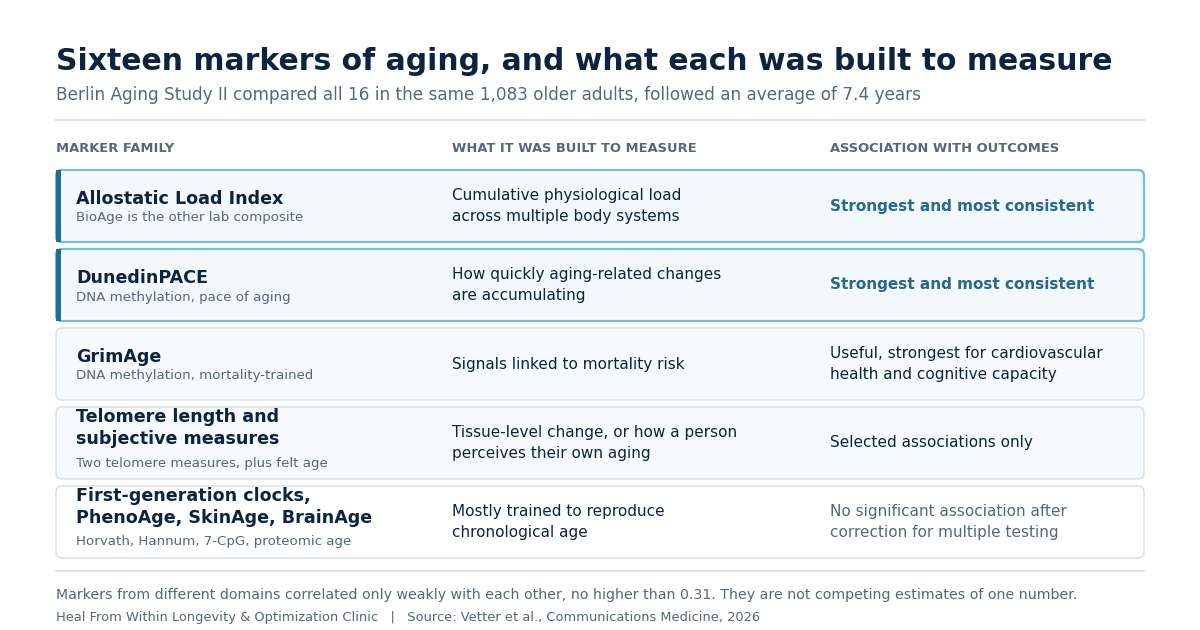
The researchers placed very different measures side by side. Six were DNA-methylation measures, including Horvath, Hannum, PhenoAge, GrimAge, a 7-CpG clock and DunedinPACE. Two were measures of telomere length. The rest were a proteomics-based age, SkinAge, BrainAge derived from MRI, two laboratory composites called BioAge and the Allostatic Load Index, and three psychological measures covering felt age and expected years of life or health.
These measures often travel under the same label, but they were not built to answer the same question.
- Early epigenetic clocks were trained largely to reproduce chronological age from methylation patterns.
- GrimAge was designed around mortality-related information rather than calendar age.
- DunedinPACE estimates how quickly aging-related changes are accumulating, closer to a speedometer than an odometer.3
- BrainAge compares imaging patterns against age-related patterns in the brain.
- Allostatic load summarizes dysregulation across multiple physiological systems using routine laboratory values.
- Subjective measures capture how a person perceives their own remaining time and health.
Markers drawn from different domains correlated only weakly to moderately with one another, with correlations no greater than 0.31 in absolute value. Markers built from the same underlying data agreed more closely, as expected. That pattern is not noise. It is evidence that these tests are not competing estimates of a single hidden quantity called biological age.
Which markers performed best?
Across the study’s physical, metabolic, cardiovascular, cognitive, psychological and functional outcomes, two measures stood out for the strongest and most consistent associations, both at baseline and over time: the Allostatic Load Index and DunedinPACE. GrimAge also performed well, particularly for cardiovascular health and cognitive capacity.
Allostatic load was the only marker that remained significantly associated with incident impairment after the study’s stringent correction for multiple comparisons. When each marker was added to a basic prediction model containing only age and sex, several improved the model’s ability to discriminate who would develop a problem over the following 7.4 years.
| Marker added to the age and sex model | Outcome 7.4 years later | Gain in model discrimination |
|---|---|---|
| Allostatic Load Index | Incident type 2 diabetes | 24 percentage points |
| Allostatic Load Index | Cardiovascular health (Life’s Simple 7) | 20 percentage points |
| Allostatic Load Index | Metabolic syndrome | 18 percentage points |
| DunedinPACE | Cardiovascular health (Life’s Simple 7) | 8 percentage points |
| DunedinPACE | Metabolic syndrome | 5 percentage points |
| DunedinPACE | Frailty (Fried phenotype) | 4 percentage points |
| GrimAge | Cardiovascular health (Life’s Simple 7) | 5 percentage points |
The widely repeated “up to 24 percentage points” headline needs care. It describes improvement in how well a model separates people who later developed a condition from people who did not, in this dataset, against a comparison model that knew only age and sex. It does not mean a test reduced anyone’s disease risk by 24 percent, and it does not show that lowering a score prevents disease.
Why a routine lab composite kept pace with a molecular clock
One of the more interesting results is that a composite built from familiar clinical measures performed at least as well as a molecular pace-of-aging clock. The Allostatic Load Index is intended to reflect cumulative physiological burden carried across systems. In BASE-II it also accounted for relevant medication use, so successfully treated dysregulation was not mistaken for an absence of underlying risk.
There is an important caveat. Some components of the index overlap conceptually with the outcomes it was used to predict. The investigators repeated the analyses after removing overlapping variables, and in almost all cases the associations remained statistically significant. Even so, when allostatic load was added to a fuller clinical model that already included age, sex, body mass index, smoking and alcohol, its added value for several cardiometabolic outcomes shrank by as much as 17 percentage points.
That is not a reason to dismiss the measure. It is the practical standard any new biomarker should be held to: judge it by what it adds beyond information a clinician can already obtain. An impressive number in a simplified research model often becomes a smaller number when the comparison is a thorough clinical assessment rather than age alone.
What “no significant association” did not mean
After correction for the large number of statistical tests, the investigators did not find significant associations across the examined outcomes for the first-generation epigenetic clocks, PhenoAge age acceleration, SkinAge, proteomic age acceleration or BrainAge. BrainAge was available in only 255 participants, which limited statistical power, and the cohort covered a relatively narrow age range of roughly 60 to 80 years at recruitment.
That result should not be read as a universal verdict on those measures. It reinforces a basic rule of measurement: performance depends on the outcome, the population and the time horizon. A brain-derived measure may be far more informative for a specific neurologic question than for a broad composite of metabolic and functional outcomes. A clock trained to predict chronological age should not be expected to behave like one trained on mortality or on longitudinal physiological decline. Published validation frameworks for aging biomarkers make the same point: a marker’s intended use has to be defined before its performance can be judged.4
What this study cannot tell you
- It was observational, so it cannot establish causation or support a treatment recommendation.
- Participants were healthier and more educated than the general population, which limits how far the findings generalize.
- The younger BASE-II cohort was not included in this analysis, and the older cohort spanned a narrow age range.
- There was attrition between baseline and follow-up. Of 588 participants who dropped out, 126 were confirmed to have died, and reasons for the remaining 462 were not systematically evaluated.
- Many marker and outcome combinations were tested, so conservative correction was necessary, which may have caused some real associations to be missed.
The larger point is that predictive validity is not the same thing as demonstrated clinical utility. A marker can forecast an outcome and still fail to improve care. Establishing utility requires prospective studies showing that decisions guided by a marker lead to better results than good conventional care, ideally measured by endpoints that matter to people, such as preserved function, fewer complications or better quality of life. The BASE-II authors state plainly that their design does not support clinical recommendations.
How Heal From Within uses biological age testing
At Heal From Within Longevity & Optimization Clinic in Hillsdale, New Jersey, the role of biological age testing is not to hand a person a verdict. It is to improve the questions that follow. A well-interpreted result organizes a broader health picture, points to systems that deserve closer attention, and creates a baseline for future comparison. It is read alongside conventional laboratory data, history, symptoms, function and risk factors, not in place of them. The BASE-II results sharpen that approach in four ways.
Ask what the test was built to measure
A pace-of-aging measure, an organ-oriented measure and a chronological-age predictor are not interchangeable, and a result from one does not settle a question the other was designed for. Knowing which question a panel was built to answer is the first step in reading it honestly.
Cross-check the signal
If a marker suggests accelerated aging, the next step is to look for agreement or tension elsewhere: metabolic health, cardiovascular risk, inflammation, cognition, mobility, recovery and daily function. A signal echoed in several places is worth acting on sooner than one that stands alone.
Prioritize decisions, not data volume
A test earns its place when it changes what gets investigated, monitored or discussed. More scores do not automatically create more clarity. A panel ordered because it is available, rather than because it will change something, is a cost with no decision attached.
Follow trajectories
A single measurement reflects biology, assay variation and context on the day it was taken. Repeat testing is informative when the interval suits the marker and the same method is compared against clinically meaningful change. That is why a retest interval is set deliberately rather than by habit.
This is the same sequence used across the practice: discover what is happening, correct what is dysregulated, optimize what is working, and monitor the trajectory. It also guards against a common mistake, treating the score itself as the therapeutic target. A person can improve blood pressure, insulin sensitivity, strength, sleep and cardiovascular fitness without every clock moving together. Those changes matter because they are meaningful health outcomes, not because an algorithm registers them.
A better goal than a younger number
The 2026 BASE-II analysis is encouraging, because several biological aging measures carried information about health years before problems became clinically apparent. That is a real argument for measuring. It is also sobering, because no single clock captured the whole person.
The practical goal is not to collect the youngest possible age estimate. It is to understand which biological systems appear resilient, which are carrying excess load, which findings are actionable, and whether the overall trajectory is moving toward better function and lower risk. Biological age testing is most credible when it helps answer those questions, and least credible when the number becomes the entire story.
Frequently asked questions
Is one biological age test more accurate than the others?
Not in a general sense. In BASE-II, the Allostatic Load Index and DunedinPACE showed the strongest and most consistent associations with health outcomes, and GrimAge performed well for cardiovascular and cognitive measures. But accuracy is always accuracy for a stated purpose. A marker that performs well against metabolic and functional outcomes may not be the right tool for an organ-level or neurologic question.
What does DunedinPACE measure?
DunedinPACE is a DNA-methylation measure of how quickly aging-related changes are accumulating, rather than an estimate of how old someone appears biologically. It was developed from a birth cohort followed across two decades, tracking change in multiple organ-system indicators over time. Conceptually it behaves more like a speedometer than an odometer.
What is the Allostatic Load Index?
It is a composite score built from routine laboratory and clinical measures, designed to reflect cumulative physiological burden across multiple body systems. In the BASE-II version, medication use was factored in, so successfully treated dysregulation was not read as an absence of risk. It requires no specialized molecular assay, which is part of why its performance drew attention.
Does a biological age result tell me my risk of a specific disease?
Not on its own. In this study, adding certain markers to a model containing age and sex improved how well that model separated people who later developed conditions such as type 2 diabetes or metabolic syndrome from those who did not. That is a statement about groups and models, not a personal risk figure. A clinician interprets a result alongside conventional testing, history, symptoms and function.
Why did some well-known epigenetic clocks show no significant association?
The first-generation clocks were trained mainly to reproduce chronological age, so they are not designed to track the physiological decline this study measured. This cohort was also healthier than average and spanned a narrow age range, and BrainAge was available in only 255 participants. A null result under those conditions is not evidence that a measure has no value.
Should the biological age score itself be the treatment target?
No. The score is a signal, not a diagnosis, a prognosis or a treatment plan. The measurable goals are the health outcomes underneath it: blood pressure, insulin sensitivity, body composition, strength, sleep, cardiovascular fitness and daily function. Those improvements matter whether or not every marker moves in the same direction.
Does this study mean biological age testing is not worth doing?
The opposite, with a condition attached. The authors found that several markers carried information about future impairment years before it became clinically apparent, and they describe that as real potential for early risk stratification. The condition is that the result has to be matched to a purpose and read in clinical context rather than treated as a verdict.
Is the epigenetic testing HFW uses the same as what this study measured?
Partly. DunedinPACE, one of the two best-performing markers in BASE-II, is among the reports included in the epigenetic panel HFW uses. This study did not evaluate any commercial testing product, so it says nothing about a specific vendor’s panel. What it supports is the general principle that pace-of-aging measures and composite laboratory markers carry useful information when they are interpreted properly.
References
- Vetter VM, Drewelies J, Homann J, et al. Comprehensive cross-sectional and longitudinal comparison of sixteen markers of biological aging from the Berlin Aging Study II. Communications Medicine. 2026;6:168. The primary comparative analysis this article is based on.
- Max Planck Institute for Human Development. Berlin Aging Study II (BASE-II) project overview. The cohort’s own description of its design, recruitment and ongoing follow-up.
- Belsky DW, Caspi A, Corcoran DL, et al. DunedinPACE, a DNA methylation biomarker of the pace of aging. eLife. 2022;11:e73420. The paper that introduced and validated DunedinPACE.
- Moqri M, Herzog C, Poganik JR, et al. Validation of biomarkers of aging. Nature Medicine. 2024;30(2):360-372. A consensus review setting out how aging biomarkers should be validated before clinical use.
Related reading
- Longevity and biological age optimization at HFW
- Advanced health testing: what HFW measures and why
- What does the DUTCH test show that a blood test doesn’t?
- Is peptide therapy evidence-based?
Written by the HFW clinical team. Medically reviewed by Dr. Eric Landi, KICP, DC on September 7, 2026.
Testing is generally available nationwide. The exact treatment service depends on the patient’s state, clinician authorization, laboratory rules, pharmacy requirements, and the therapy involved.
This article is educational and does not provide individualized medical advice. It does not establish a clinician-patient relationship. Individual questions about your own health belong with an HFW advanced care clinician or your own physician. If you are experiencing a medical emergency, call 911 or go to your nearest emergency department.
Schedule a complimentary introductory call with an HFW advanced care clinician.