
Perimenopause can start years before the final period, and the first clue is not always a missed cycle.
Medically reviewed by Christina Warner, APN-C. Updated September 8, 2026.
Common signs of perimenopause include changes in menstrual timing or flow, hot flashes or night sweats, sleep disruption, mood changes, difficulty concentrating, vaginal or urinary changes, lower libido, fatigue, and joint or muscle discomfort. Perimenopause is the transition leading up to menopause and can begin years before periods stop completely. Symptoms vary, and no single symptom confirms it.12
What is perimenopause?
Perimenopause is the transition leading up to natural menopause. During this time, menstrual cycles may become less predictable as ovarian hormone production changes. Menopause is reached retrospectively, after 12 consecutive months without a menstrual period or spotting.1
Perimenopause is not a single moment or a single hormone level. Some women first notice changes in cycle timing or flow. Others notice hot flashes, night sweats, sleep disruption, vaginal changes, mood changes, difficulty concentrating, or changes in how their joints and muscles feel. The pattern and intensity vary substantially from person to person.12
A symptom list can help someone recognize a pattern worth discussing, but it cannot determine whether that person is in perimenopause. Age, menstrual history, symptoms, medications, reproductive history, and other possible medical explanations all matter.
What are the most common signs of perimenopause?
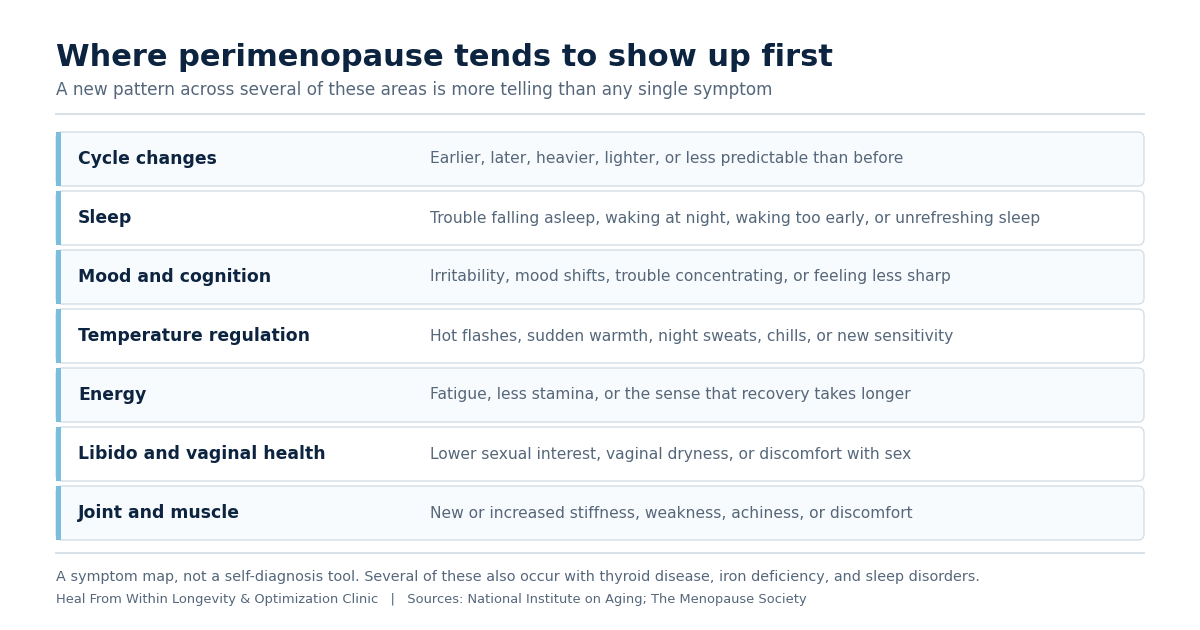
The most common signs include menstrual cycle changes, hot flashes and night sweats, sleep problems, mood changes, difficulty concentrating, vaginal dryness or discomfort, urinary changes, changes in sexual interest, and joint or muscle discomfort. Menstrual changes are often among the earliest noticeable signs, but symptoms do not always appear in a predictable order.12
| Symptom category | What patients commonly notice |
|---|---|
| Cycle changes | Periods becoming earlier, later, heavier, lighter, shorter, longer, or less predictable than before |
| Sleep | Trouble falling asleep, waking during the night, waking too early, or sleep that no longer feels restorative |
| Mood and cognition | Irritability, mood shifts, difficulty concentrating, forgetfulness, or feeling mentally less sharp |
| Temperature regulation | Hot flashes, sudden warmth, night sweats, chills, or new temperature sensitivity |
| Energy | Fatigue, reduced stamina, or feeling that recovery takes longer |
| Libido and vaginal health | Lower sexual interest, vaginal dryness, changes in arousal, or discomfort with sex |
| Joint and muscle | New or increased stiffness, weakness, achiness, or musculoskeletal discomfort |
A useful clinical clue is a new pattern rather than one isolated symptom. A woman may notice that periods are becoming less predictable at the same time that sleep is worsening or night sweats are appearing. Another woman may notice several months of subtle cycle changes before other symptoms become obvious. These patterns can be consistent with the menopause transition, but they are not specific enough to diagnose it without clinical context.12
At what age does perimenopause usually begin?
Most women begin the menopausal transition between ages 45 and 55, although the timing varies. Some women notice changes earlier, and women who develop symptoms or major menstrual changes at a younger age may require evaluation for other causes or for earlier loss of ovarian function.1
Age helps establish context, but it does not establish the diagnosis by itself. A woman in her late 40s with new cycle irregularity and hot flashes has a different clinical context from a woman in her 20s or 30s with the same symptoms. The younger patient may require a different evaluation.
The practical point is that symptoms can begin years before periods stop completely. A woman does not need to wait until menopause itself to raise new cycle changes, hot flashes or night sweats, sleep problems, or other persistent concerns with a clinician.1
Why are perimenopause symptoms so often missed?
Perimenopause can be easy to overlook because symptoms may develop gradually, may not occur together, and may overlap with other health problems. Someone may focus on insomnia, fatigue, mood changes, or brain fog without immediately connecting those symptoms with changes in menstrual pattern or hot flashes.1
Hormone production also changes across the transition rather than switching from one stable state to another overnight. The Menopause Society describes the ovaries’ production of hormones during this time as erratic.2 The National Institute on Aging notes that clinicians often use age, symptoms, and family history to judge whether the menopausal transition is the likely explanation, and may suggest a blood test in some cases, such as when periods stopped at an early age.1
That does not mean every unexplained symptom with a normal laboratory result is hormonal. It means that, specifically during the menopause transition, reproductive hormone values have to be interpreted in the context of symptoms and menstrual history. HFW keeps that question narrow rather than treating normal labs as evidence of hidden dysfunction in general.
Can a blood test confirm perimenopause?
A single hormone blood test cannot capture the entire perimenopause transition. Reproductive hormone levels fluctuate across the transition, so one value is a snapshot rather than the whole picture. Testing can still be useful in selected situations, especially when menstrual history is unclear, when symptoms occur unusually early, or when another diagnosis is being considered.12
At HFW, testing is meant to answer a clinical question rather than produce a diagnosis from one number. Depending on the presentation, a clinician may review reproductive hormone testing along with thyroid, metabolic, hematologic, or other relevant information. What is appropriate depends on the patient’s age, cycle pattern, symptoms, history, medications, and safety considerations. The Endocrine Society clinical practice guideline supports evaluating the menopause transition using clinical menstrual criteria rather than a single hormone measurement.3
What else can cause these same symptoms?
Perimenopause shares symptoms with several other conditions, which is one reason a clinician may need to look beyond a hormone panel.
- Hypothyroidism can cause fatigue, weight gain, trouble tolerating cold, joint and muscle pain, depression, and heavy or irregular menstrual periods. Because these overlap with common midlife complaints, symptoms alone cannot distinguish thyroid disease from perimenopause.4
- Iron-deficiency anemia can cause tiredness, dizziness or lightheadedness, and shortness of breath. Heavy menstrual periods are themselves a route to iron loss, so a woman with changing cycles and worsening fatigue may need evaluation for both the bleeding pattern and its consequences.5
- Sleep apnea can cause daytime sleepiness, fatigue, insomnia, problems with focusing, decreased libido, and waking often at night to urinate. Fatigue and insomnia are noted as more common presentations in women.6
Pregnancy, medication effects, mood disorders, abnormal uterine bleeding conditions, and other gynecologic or medical issues can also change the evaluation. New or unusually heavy bleeding, bleeding between periods, bleeding after sex, or bleeding after 12 months without a period should not automatically be attributed to perimenopause.12
How Heal From Within evaluates perimenopause symptoms
At Heal From Within Longevity & Optimization Clinic in Hillsdale, New Jersey, the goal is to evaluate the full pattern before deciding what should happen next. Christina Warner, APN-C, is a Board-Certified Women’s Health Nurse Practitioner whose work at HFW includes women’s health, hormone care, metabolic care, functional and integrative medicine, and longitudinal monitoring.
An HFW evaluation may consider the patient’s symptoms, menstrual and reproductive history, previous hormone care, breast and uterine history, abnormal bleeding history, medications, migraines, cardiovascular and clotting context, sleep, mood, sexual health, energy, metabolic concerns, and prior testing. Relevant laboratory testing may be used when the result could clarify the picture, identify another possible contributor, establish a useful baseline, or change a clinical decision.
The objective is not to prove that every symptom comes from hormones. It is to determine which findings appear connected, which possible contributors deserve attention, and what the narrowest useful next step should be. Booking an evaluation does not guarantee a prescription or any particular therapy.
HFW organizes care around four phases. Discover means understanding symptoms, history, goals, and useful data. Correct means addressing the most important clinical priorities first. Optimize means considering additional support only when the clinical context justifies it. Monitor means following symptoms, relevant biomarkers, response, and safety over time so the plan can change when the patient changes.
Frequently asked questions
Is perimenopause the same as menopause?
No. Perimenopause is the transition leading up to natural menopause. Menopause is reached after 12 consecutive months without a menstrual period or spotting, and it is identified looking back rather than at the time it happens.
How long does perimenopause last?
The length varies substantially. The National Institute on Aging notes that symptoms related to menopause can last between two and eight years, and that the timing and the symptoms themselves are highly variable among women.
Can you have perimenopause symptoms with a normal hormone panel?
Yes. Reproductive hormone levels can fluctuate during the menopause transition, so one hormone value does not provide the whole clinical picture. Menstrual history, symptoms, age, medications, and other relevant information still matter. This is a point about reproductive hormones specifically, not a general claim that normal results hide dysfunction.
Does perimenopause cause weight gain?
Body composition and fat distribution can change during the menopausal transition, and some women may gain weight more easily. Weight change is still multifactorial, so sleep, activity, nutrition, muscle mass, medications, metabolic health, and other contributors should also be considered.
Can perimenopause affect sleep and mood?
Yes. Sleep disruption, night sweats, mood changes, irritability, and difficulty concentrating are commonly reported during the menopause transition. These symptoms can also have other causes, including thyroid disease, iron deficiency, and sleep disorders, so persistent or significant changes deserve clinical review.
Should you track your cycle during perimenopause?
Tracking can be useful because changes in timing, flow, skipped periods, and bleeding pattern give a clinician more context than memory alone. The Menopause Society suggests tracking bleeding on a calendar or smartphone app so that it can be easily reviewed and assessed.
What testing does HFW use to evaluate hormone symptoms?
HFW may use targeted bloodwork and other testing when it answers a specific clinical question. Testing is selected based on symptoms, age, menstrual history, medical history, medications, safety considerations, and whether the result is likely to change a decision. Ordering a larger panel is not the goal.
When should you talk to a clinician about these symptoms?
Talk with a clinician when symptoms are affecting sleep, work, relationships, sexual health, exercise, or quality of life, or when menstrual changes are new or difficult to interpret. New heavy bleeding, bleeding between periods, bleeding after sex, or bleeding after a full year without a period warrants medical evaluation. Severe, rapidly worsening, or potentially life-threatening symptoms require urgent or emergency care.
References
- National Institute on Aging, National Institutes of Health. What Is Menopause? The federal patient-education page on menopause timing, symptoms, and how clinicians assess the transition.
- The Menopause Society. Perimenopause. The specialty society’s patient-education page on the transition and tracking bleeding changes.
- Stuenkel CA, Davis SR, Gompel A, et al. Treatment of Symptoms of the Menopause: An Endocrine Society Clinical Practice Guideline. The Journal of Clinical Endocrinology & Metabolism. 2015;100(11):3975-4011. The Endocrine Society’s clinical practice guideline on evaluating and treating menopause symptoms.
- National Institute of Diabetes and Digestive and Kidney Diseases, National Institutes of Health. Hypothyroidism (Underactive Thyroid). The federal reference for hypothyroidism symptoms, which overlap with the menopause transition.
- National Heart, Lung, and Blood Institute, National Institutes of Health. Iron-Deficiency Anemia. The federal reference for iron-deficiency anemia symptoms and causes, including heavy menstrual bleeding.
- National Heart, Lung, and Blood Institute, National Institutes of Health. Sleep Apnea Symptoms. The federal reference for sleep apnea symptoms, including presentations more common in women.
Related reading
- Menopause and hormonal health at HFW
- HFW hormone replacement therapy care
- Advanced health testing: what HFW measures and why
- What does the DUTCH test show that a blood test doesn’t?
Written by the HFW clinical team. Medically reviewed by Christina Warner, APN-C on September 8, 2026.
Testing is generally available nationwide. The exact treatment service depends on the patient’s state, clinician authorization, laboratory rules, pharmacy requirements, and the therapy involved.
This article is educational and does not provide individualized medical advice. It does not establish a clinician-patient relationship. Individual questions about your own health belong with an HFW advanced care clinician or your own physician. If you are experiencing a medical emergency, call 911 or go to your nearest emergency department.
Schedule a complimentary introductory call with an HFW advanced care clinician.