
The cheapest vial and the lowest-risk decision are not the same purchase.
Medically reviewed by Christina Warner, APN-C. Updated September 9, 2026.
Yes, if you mean buying an injectable peptide to use as a treatment. That is a drug use, not laboratory research, and legitimate access ordinarily runs through a licensed clinician and an authorized dispensing pathway. A site that will sell you the same molecule with no prescription is not offering a cheaper version of the same thing. It is offering a different thing.
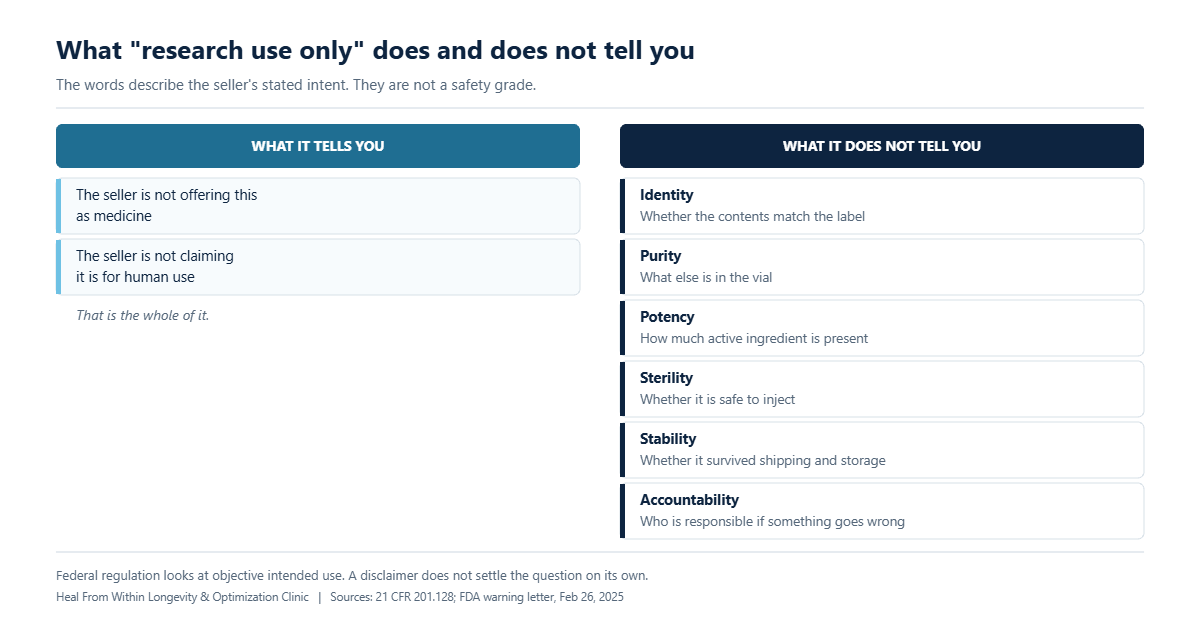
What “research use only” actually means
A genuine laboratory reagent can appropriately be sold for research. But the words “research use only” and “not for human consumption” are not a safety grade. They do not establish that a finished vial has been reviewed for identity, purity, potency, sterility, or stability, and they do not tell you that anything in it was checked against a standard meant for people.
Those words are also not a legal shield that settles the question. Federal regulation looks at objective intended use, and the evidence for that can include labeling claims, advertising, oral or written statements, the product’s design, and the circumstances of distribution.1 A disclaimer sitting underneath marketing aimed at people does not automatically win.
The FDA has said so directly. In a warning letter issued in February 2025, the agency took the position that a seller’s products were unapproved new drugs intended for human use despite research-only and not-for-human-consumption disclaimers on the site. The same letter warned that products sold outside those safeguards may be contaminated or counterfeit, may contain varying amounts of the active ingredient, or may contain a different ingredient altogether.2
For someone deciding what to buy, the practical reading is simpler than the legal one. The seller is telling you, in writing, that they are not presenting this vial to you through a pathway meant for human medicine. A posted certificate of analysis is some information, but it is not the same as knowing who made the finished product, which lot it came from, what standards governed it, and whether anyone is authorized to supply medicine to you at all.
A website can be legitimate. The question is what kind.
Plenty of licensed pharmacies dispense prescriptions online, and that is a different category from a research-chemical storefront. The FDA tells consumers that a safe online pharmacy always requires a prescription from a doctor, is licensed with a state board of pharmacy, provides a physical address and telephone number in the United States, and has a licensed pharmacist on staff to answer questions.3
So the useful question is not whether you can click a buy button. It is what legal and clinical system stands behind the transaction. Convenience is not the problem. The absence of an accountable pathway is.
The real difference is an accountability trail
Two offers can display the same peptide name and similar-looking vials and still not be the same purchase. What separates them is whether identifiable people and facilities stand behind the product, whether documentation survives the sale, and whether there is a route for investigating a problem later.
| Question | Anonymous research vial | Clinician-ordered treatment |
|---|---|---|
| Who decided this was appropriate for you? | You did, from a product page | A licensed clinician who reviewed your history |
| Who made the finished vial? | Often not disclosed | A named pharmacy or manufacturer |
| What happened before the first dose? | Nothing required | History review and relevant testing |
| Who is watching afterward? | No one | The clinician who ordered it |
| What happens if something changes? | You are on your own | Documented, reviewed, adjusted or stopped |
| Who is responsible? | Nobody identifiable | A licensed professional and a licensed facility |
A clinic label is not an automatic all clear
A prescription matters, but it should not end the questions. Compounded drugs are not FDA-approved, meaning the agency does not verify their safety, effectiveness, or quality before they are marketed. The FDA’s position is that compounded drugs should be used in patients whose medical needs cannot be met by an FDA-approved drug, and that unnecessary use can expose people to serious risks.4
The agency has also identified potential significant safety risks for a number of substances that were nominated for use in compounding, citing concerns such as immunogenicity, aggregation, impurities, and limited human safety information.5 That is not the same as a ban, and it does not describe every peptide. It does mean the regulatory picture moves, and it is specific to individual substances rather than to the category as a whole.
The practical consequence is a fair question to ask any clinic: what is the current regulatory status of the specific product you are recommending for me, and why is this route appropriate in my case? “It is compounded” is a description, not an answer.
What quality claims do and do not tell you
Words like “GMP,” “registered,” and “pharmaceutical grade” appear on both sides of this decision, and none of them means approval. Registration of a facility is not approval of a product.
The distinction that matters is that these terms describe how something was made. They do not describe whether a particular product may lawfully be supplied to a patient for a particular use. Both things can be true at once, and only the second one answers the question a patient is actually asking.
What the prescription is supposed to buy
The vial is one part of peptide care, and the easiest part to put a price on. The rest is the work around it: reviewing health history and goals, deciding whether treatment is appropriate at all, checking relevant safety markers, teaching correct injection technique where that applies, monitoring response, repeating testing when it will change something, and stopping or changing the plan when the evidence points elsewhere.
A prescription by itself does not guarantee any of that happened. A thin telehealth encounter can produce one with very little assessment behind it. The value is in the clinical system around the prescription, and in whether anyone remains responsible after the payment clears.
That also makes the price comparison more honest. A research-vial site may charge less partly because the purchase excludes evaluation, testing, injection support, follow-up, and clinical responsibility. A clinic can still overcharge or underdeliver, which is why it is reasonable to ask exactly what is included. But a lower product price is not evidence that the two offers are equivalent.
How Heal From Within approaches peptide care
Heal From Within is a clinician-led longevity and health optimization practice based in Hillsdale, New Jersey, with physician medical direction. Peptide programs are not structured as low-cost product distribution. They are built around testing or lab review first, injection support where it applies, and multiple clinician consultations, with monitoring and adjustment after.
Discover
A clinician reviews health history, goals, medications, and relevant testing before deciding whether a peptide is appropriate. That review is also what surfaces the reasons not to proceed.
Correct
Anything correctable that would undercut the result, or make the therapy inappropriate, is addressed before a compound is added. A peptide layered on top of an unaddressed problem is not a shortcut.
Optimize
Where a therapy is appropriate, it sits inside a broader plan rather than standing in for one. Sleep, nutrition, training load, and medication review usually carry more weight than any single compound.
Monitor
Response is tracked, testing is repeated when the result could change a decision, and the plan is adjusted or stopped based on what comes back. Someone stays responsible after the first order.
What a clear answer sounds like
The practical difference between the two routes is that one of them has someone to ask. A clinician who has thought a plan through can explain why this route fits your situation, what was reviewed before treatment started, and who is watching afterward. Those answers come easily, because they are the same things the clinician had to settle in order to make the decision.
Two things are worth understanding before you start, whichever route you are considering. The first is what happens before treatment: what history is reviewed, what testing is relevant, why the therapy fits, and what would change the decision. The second is who owns follow-up: who reviews new symptoms or laboratory changes, and who decides whether to continue, adjust, or stop.
A research vial cannot answer either question, because there is no one on the other end of it. That is the difference worth paying attention to.
The bottom line
If a peptide is being offered to treat a person or change how the body functions, it belongs in the drug conversation, not the supplement aisle and not behind a research-use-only wink. The label does not tell you the vial is safe. A clinic name does not tell you the treatment is appropriate. A quality claim does not tell you the product is lawfully marketed for you.
What matters is whether the decision and the product can be traced to accountable people: who evaluated you, who ordered it, who made it, which rules applied, who monitors you, and who responds if something goes wrong. One route sells a vial. The other should provide supervision. When the decision is about a drug you plan to put into your body, those are not the same purchase.
Frequently asked questions
Do peptides require a prescription?
If a peptide is being used as a treatment in a person, that is a drug use, and legitimate access ordinarily requires a licensed clinician and an authorized dispensing pathway. Products sold online with no prescription are generally presented as laboratory reagents rather than as medicine, which is a different legal category and a different level of oversight.
What does “research use only” mean on a peptide vial?
It represents the seller’s stated position that the product is not intended for people. It is not a safety grade and it does not confirm identity, purity, potency, sterility, or stability for human use. Federal regulation looks at objective intended use, and evidence such as advertising, statements, product design, and circumstances of distribution can contradict a disclaimer.
Is it safe to buy peptides online without a prescription?
Buying outside a regulated pathway means no one has verified what is in the vial and no one is accountable for what happens next. The FDA has warned that products sold outside those safeguards may be contaminated or counterfeit, may contain varying amounts of active ingredient, or may contain a different ingredient than labeled.
How can I tell a legitimate online pharmacy from a research storefront?
The FDA advises looking for a pharmacy that always requires a prescription, is licensed with a state board of pharmacy, provides a physical address and telephone number in the United States, and has a licensed pharmacist on staff to answer questions. A site that skips the prescription is not a cheaper pharmacy, it is a different kind of business.
Are compounded peptides FDA-approved?
No. Compounded drugs are not FDA-approved, which means the agency does not verify their safety, effectiveness, or quality before they are marketed. Compounding serves a real purpose when an approved product is not medically appropriate or available for a particular patient, and that reasoning should be explained rather than assumed.
Does a prescription mean the therapy is appropriate for me?
Not by itself. A brief encounter can produce a prescription with very little assessment behind it. What makes a prescription meaningful is the evaluation before it, the monitoring after it, and whether a named clinician remains responsible for the plan.
Does HFW publish peptide dosing?
No. Dosing, frequency, and protocol details are individual clinical decisions that depend on the person, the product, and the monitoring plan. They belong in a consultation with a clinician who has evaluated you, not in a public article.
References
- 21 CFR 201.128, Meaning of “intended uses.” The federal regulation defining how objective intended use is determined, including labeling, advertising, statements, design, and circumstances of distribution.
- U.S. Food and Drug Administration. Warning Letter, USApeptide.com. February 26, 2025. The agency’s position that research-only disclaimers did not prevent products from being unapproved new drugs intended for human use.
- U.S. Food and Drug Administration. How to Buy Medicines Safely From an Online Pharmacy. Consumer criteria for identifying a legitimate online pharmacy, and the risks of buying outside one.
- U.S. Food and Drug Administration. Compounding and the FDA: Questions and Answers. The agency’s guidance that compounded drugs are not FDA-approved and when compounding is appropriate.
- U.S. Food and Drug Administration. Certain Bulk Drug Substances for Use in Compounding That May Present Significant Safety Risks. The agency’s current list of nominated substances flagged for potential significant safety concerns.
Related reading
- Are peptides safe? A clinician-led safety guide
- Is peptide therapy evidence-based?
- Peptide therapy at HFW
- Advanced health testing: what HFW measures and why
Written by the HFW clinical team. Medically reviewed by Christina Warner, APN-C on September 9, 2026.
Testing is generally available nationwide. The exact treatment service depends on the patient’s state, clinician authorization, laboratory rules, pharmacy requirements, and the therapy involved.
This article is educational and does not provide individualized medical advice. It does not establish a clinician-patient relationship. Individual questions about your own health belong with an HFW advanced care clinician or your own physician. If you are experiencing a medical emergency, call 911 or go to your nearest emergency department.
Schedule a complimentary introductory call with an HFW advanced care clinician.