
Low testosterone is not a symptom checklist and TRT is not the automatic answer.
Medically reviewed by Christina Warner, APN-C. Updated September 17, 2026.
Reduced sex drive, fewer morning erections, erectile changes, falling strength and slower recovery are the signs that most often justify testing. None of them is diagnostic on its own. Hypogonadism requires compatible symptoms together with testosterone that is consistently low on properly timed, repeated measurement, and an explanation for why it is low.
Which symptoms deserve attention?
Sexual symptoms carry more diagnostic weight than general complaints, although none establishes a diagnosis by itself. The signs that most often prompt an evaluation are:
- Reduced sexual desire or sexual activity
- Fewer spontaneous or morning erections
- Erectile dysfunction, particularly alongside other compatible symptoms
- Reduced muscle mass, strength or exercise capacity
- Loss of body hair or other changes in secondary sex characteristics
- Low bone density, unexplained anemia or fertility concerns in the appropriate clinical context
Fatigue, low motivation, depressed mood, irritability, poor concentration, disrupted sleep, weight gain and slower recovery can also occur. On their own they are weak clues, because they overlap with sleep apnea, depression, thyroid disease, obesity, diabetes, medication effects, chronic illness, overtraining and ordinary life stress.1
That overlap is not a reason to dismiss the symptoms. It is a reason to investigate them without deciding the answer in advance.
A low result is not the whole diagnosis
The Endocrine Society defines hypogonadism through two findings together: symptoms or signs consistent with testosterone deficiency, and testosterone concentrations that are unequivocally and consistently low. Its July 2026 statement is blunter still, saying that symptoms alone are not diagnostic.1
Testosterone changes across the day and from one day to the next. Food intake, acute illness, poor sleep, shift work and assay quality all affect the result. Current endocrine and urology guidance therefore calls for at least two early-morning measurements on separate occasions, generally fasting, before a man is labeled testosterone deficient.23
The number also has to match the clinical picture. A low value without compatible symptoms does not by itself establish hypogonadism. Symptoms with repeatedly normal, well-measured testosterone should widen the investigation rather than trigger a search for a more permissive cutoff.
Low production is only one possible failure point
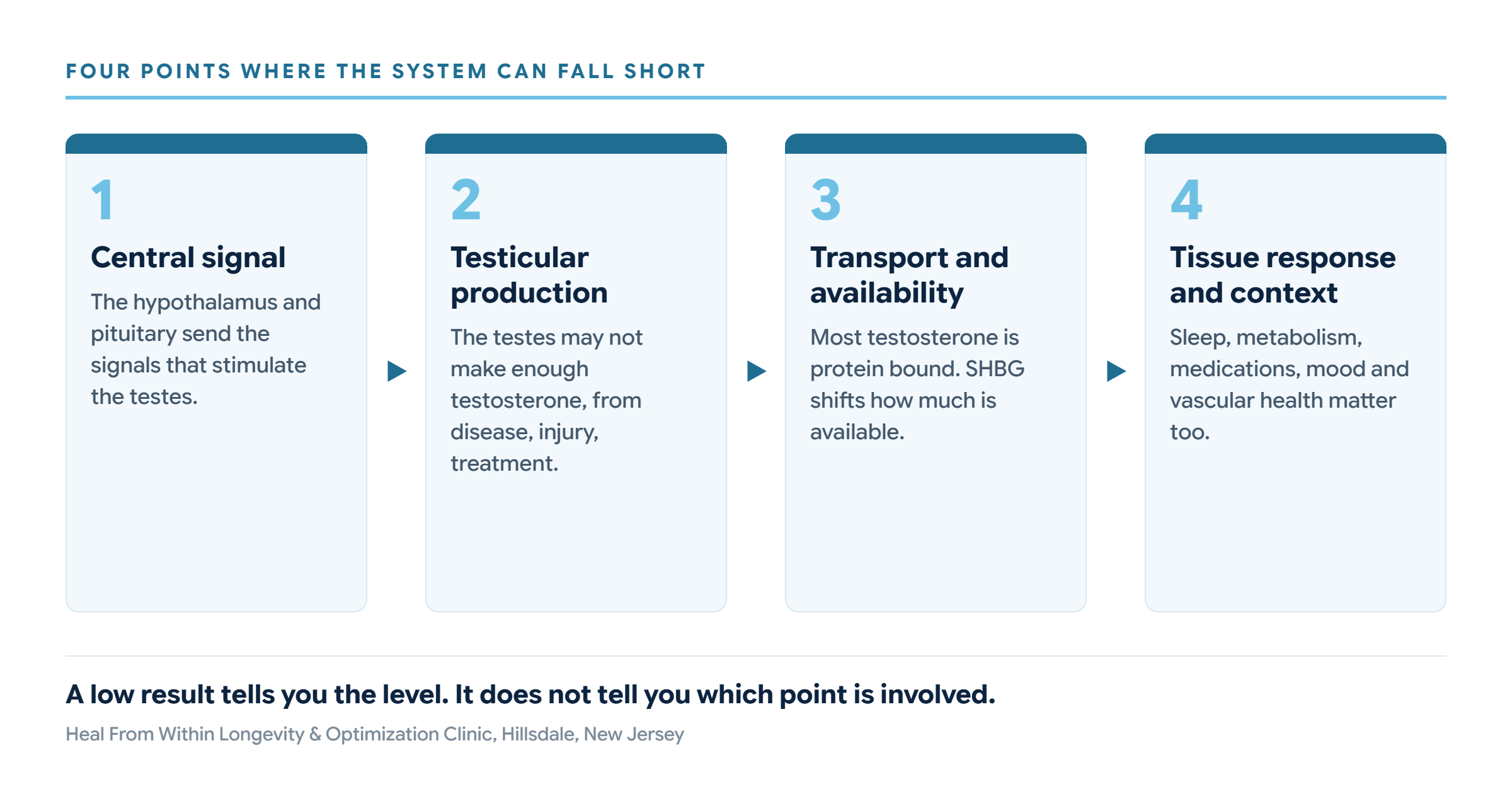
It helps to think of testosterone physiology as a chain rather than a tank that is either full or empty.
- Central signal. The hypothalamus and pituitary send the hormonal instructions that stimulate the testes. When that signaling falls, testosterone production can fall with it even though the testes are capable of responding.
- Testicular production. The testes may not produce enough testosterone because of primary gonadal disease, injury, genetic conditions, chemotherapy, radiation or other causes.
- Transport and availability. Most circulating testosterone is bound to proteins, including sex hormone-binding globulin, or SHBG. Changes in SHBG can make a total testosterone value look more or less reassuring than the amount estimated to be biologically available.
- Tissue response and context. Symptoms are shaped by far more than hormone concentration. Androgen sensitivity varies, and sleep, metabolism, inflammation, medications, mood, vascular health and neurologic factors all influence the outcomes men attribute to testosterone.
This is the clinically useful version of the distinction between production and signaling. It does not mean that every man with symptoms and a normal level has hidden androgen resistance. Routine practice has no single validated test that proves poor tissue-level testosterone signaling. It means the clinician should identify which part of the system the available evidence actually supports, and stay willing to find a different cause.
Why total testosterone may not be enough
Total testosterone is the recommended first test. It is more widely standardized than the alternatives and gives the clinician an essential reference point. It is not always the last test.2
When total testosterone sits near the lower end of the reference range, or when a condition may alter SHBG, guidelines recommend assessing free testosterone by an accurate method or calculation. SHBG shifts with age, obesity, insulin resistance, thyroid and liver conditions and certain medications. Two men with identical total testosterone can therefore have different estimated free-testosterone availability.2
This is why the phrase “my testosterone is normal” can be either reassuring or incomplete. The result has to be read against the assay, the timing, the repeatability, the SHBG context, the symptoms and the probability of another explanation. Normal should not be dismissed, but it should be understood.
Primary or secondary: what LH and FSH show
If repeat testing supports testosterone deficiency, the next question is why. Luteinizing hormone and follicle-stimulating hormone help separate a problem in the testes from reduced stimulation above them.2
| Primary hypogonadism | Secondary hypogonadism | |
|---|---|---|
| Where the problem sits | The testes | The hypothalamus or pituitary |
| What LH and FSH usually show | Elevated | Low or inappropriately normal |
| Common contributors | Primary gonadal disease, injury, genetic conditions, chemotherapy, radiation | Obesity and metabolic illness, opioids, corticosteroids, pituitary conditions, significant systemic illness |
| Why it changes the plan | Production capacity itself is limited | Some contributors are correctable, which can change whether replacement is the right first step |
The surrounding health picture matters as much as the hormone panel. Obesity and metabolic illness can suppress the hypothalamic-pituitary-testicular axis. Opioids and corticosteroids can lower testosterone. Sleep disorders reproduce many of the same symptoms. Fertility goals can change the treatment discussion entirely, because external testosterone can suppress sperm production.3
A careful evaluation is not an obstacle placed between a man and treatment. It is how treatment gets aimed at the correct problem.
When does TRT enter the conversation?
Testosterone replacement therapy can improve relevant symptoms in appropriately selected men with confirmed hypogonadism. It is not a default response to fatigue, to aging, or to a single borderline result. The decision requires review of fertility plans, blood counts, prostate and urinary considerations, cardiovascular and clotting history, sleep apnea, current medications, treatment goals, and whether the patient can complete follow-up monitoring.23
The cardiovascular conversation has moved. In the 5,246-participant TRAVERSE trial, testosterone therapy was noninferior to placebo for major adverse cardiovascular events among middle-aged and older men with confirmed hypogonadism and preexisting or elevated cardiovascular risk.4 FDA revised testosterone labeling across the class on February 28, 2025, removing the cardiovascular boxed warning and adding a warning about increased blood pressure.5 Some other findings occurred more often in the testosterone group, which is part of why monitoring is a condition of treatment rather than an optional extra. That is meaningful reassurance for the population studied. It is not evidence that testosterone therapy is free of risk, appropriate without a diagnosis, or fully characterized across decades of use.
Good care also defines in advance what success would look like. A higher laboratory value is not sufficient on its own. Symptoms, sexual function, strength, body composition, hematocrit, blood pressure and side effects can all matter, depending on the patient and the plan.
How HFW approaches a low testosterone evaluation
Heal From Within is a clinician-led longevity and health optimization practice in Hillsdale, New Jersey, with physician medical direction. For a man presenting with these symptoms, the sequence is deliberate.
Discover
Symptom history, medication review, sleep and metabolic picture, and properly timed repeat testing. Total testosterone first, with free testosterone and SHBG when the total is borderline or a condition may have altered binding, and LH and FSH once deficiency is confirmed.
Correct
Where a contributor is reversible, it is addressed. Untreated sleep apnea, significant weight and metabolic disease, and medications that suppress the axis are all capable of producing or worsening the picture, and correcting them sometimes changes the conclusion.
Optimize
Testosterone therapy is considered when the clinical case supports it, evaluated and prescribed by an authorized HFW prescriber after fertility, cardiovascular, prostate and hematologic review. It is one tool inside a monitored plan, not the plan itself.
Monitor
Response is measured against the symptoms and markers that mattered at the start, on a defined schedule, with the plan changed when the results change. The least intervention reasonably necessary, reassessed rather than assumed permanent.
The questions worth asking
If low testosterone is on your mind, these questions get you further than asking whether you can start TRT.
- Were my measurements taken under appropriate conditions, and repeated?
- Does my symptom pattern actually fit testosterone deficiency?
- Could SHBG be making my total testosterone harder to interpret?
- Do LH and FSH point to a testicular problem or to reduced central stimulation?
- Could sleep, weight, metabolic health, medications, thyroid function or mood explain the same symptoms?
- How would treatment affect my fertility?
- What will be monitored, and what result would make us change course?
The signs of low testosterone are real, and they are not exclusive to low testosterone. A good evaluation respects both halves of that sentence. It measures carefully, locates the likely failure point, corrects what is reversible, and uses testosterone only when the clinical case supports it.
Frequently asked questions
Can you have low testosterone symptoms with a normal test result?
Yes, and it is common. Fatigue, low motivation, poor concentration and reduced drive overlap with sleep apnea, depression, thyroid disease, obesity, diabetes, medication effects and chronic under-recovery. A repeatedly normal, well-measured testosterone level is a reason to widen the investigation, not a reason to hunt for a more permissive cutoff.
How many testosterone measurements are needed before a diagnosis?
Current endocrine and urology guidance calls for at least two early-morning measurements taken on separate occasions, generally fasting, before a man is described as testosterone deficient. One value is a starting point, not a diagnosis. Testosterone moves through the day and from day to day, so a single draw can mislead in either direction.
Why does testosterone have to be measured in the morning?
Testosterone follows a daily rhythm and is generally highest in the early morning, so a mid-afternoon draw can read low in a man whose levels are adequate. Food intake, acute illness, poor sleep and shift work also move the number. Standardizing the timing is what makes two results comparable.
What is SHBG, and why does it change the interpretation?
Sex hormone-binding globulin is a protein that binds testosterone in the blood. When SHBG is high or low, total testosterone can look more or less reassuring than the amount estimated to be biologically available. SHBG shifts with age, obesity, insulin resistance, thyroid and liver conditions and certain medications, which is why two men with the same total value can be in different situations.
Do LH and FSH tests matter?
They matter once low testosterone has been confirmed, because they help separate a testicular problem from reduced signaling above it. That distinction changes what is treatable and what the first step should be. They are not screening tests for symptoms alone.
Does testosterone naturally decline with age?
Average levels do fall gradually with age, but age by itself does not make a man a candidate for treatment. Guidance is built around confirmed deficiency with compatible symptoms, not around an age-adjusted expectation. Much of the decline seen in midlife tracks with weight, metabolic health, sleep and medication use rather than age alone.
Is TRT safe long term?
In appropriately selected men with confirmed hypogonadism, testosterone therapy was noninferior to placebo for major adverse cardiac events in a large randomized safety trial. Long-term use still requires ongoing monitoring, and the decision belongs with a clinician who has reviewed your fertility plans, blood counts, prostate history, cardiovascular and clotting history, sleep and medications.
Does HFW publish testosterone dosing?
No. Dosing and monitoring intervals are individual clinical decisions made by an authorized HFW prescriber after evaluation. We do not publish them as education, because a number without a patient attached to it is not information, it is a liability.
References
- Endocrine Society. Statement on Testosterone Replacement Therapy (July 16, 2026). Professional society statement on diagnostic standards for testosterone therapy.
- Bhasin S, et al. Testosterone Therapy in Men With Hypogonadism: An Endocrine Society Clinical Practice Guideline. J Clin Endocrinol Metab. 2018. Clinical practice guideline covering diagnosis, measurement and monitoring.
- Mulhall JP, et al. Evaluation and Management of Testosterone Deficiency: AUA Guideline. J Urol. 2018. Urology guideline on evaluation, confirmatory testing and treatment considerations.
- Lincoff AM, et al. Cardiovascular Safety of Testosterone-Replacement Therapy. N Engl J Med. 2023;389:107-117. The TRAVERSE randomized cardiovascular safety trial in 5,246 men.
- U.S. Food and Drug Administration. FDA issues class-wide labeling changes for testosterone products (February 28, 2025). Regulatory action revising cardiovascular and blood pressure labeling across the class.
Related reading
- Why do men lose energy, focus, and drive after 40?
- Can a gut infection cause low testosterone and brain fog?
- Testosterone evaluation and monitored treatment at HFW
- Advanced health testing
Written by the HFW clinical team. Medically reviewed by Christina Warner, APN-C on September 17, 2026.
Testing is generally available nationwide. The exact treatment service depends on the patient’s state, clinician authorization, laboratory rules, pharmacy requirements, and the therapy involved.
This article is educational and does not provide individualized medical advice. It does not establish a clinician-patient relationship. Individual questions about your own health belong with an HFW advanced care clinician or your own physician. If you are experiencing a medical emergency, call 911 or go to your nearest emergency department.
Schedule a complimentary introductory call with an HFW advanced care clinician.