
Bloodwork and DUTCH are not competing versions of the same test.
Medically reviewed by Christina Warner, APN-C. Updated September 10, 2026.
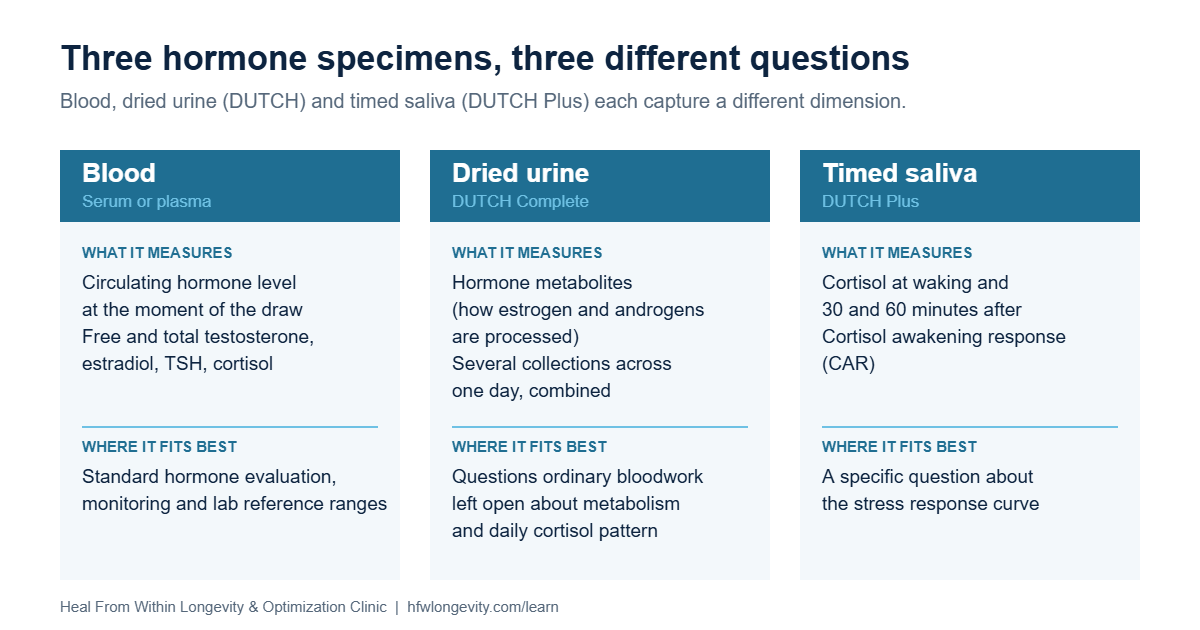
A blood test measures how much of a hormone is circulating at the moment it is drawn. A DUTCH panel adds selected hormone metabolites in urine and a view across several collections in one day, and DUTCH Plus adds timed saliva to capture the cortisol awakening response. Those dimensions are useful when they answer a question ordinary evaluation left open.
The more useful question is not which test is deeper. It is which test answers the clinical question in front of you.
A blood test is a time-stamped view
Blood is where many hormones circulate before reaching tissues, so blood testing is often the most direct and clinically established way to answer questions about current concentration. Depending on the hormone and the reason for testing, a clinician may use it to evaluate a possible endocrine disorder, establish a baseline, assess eligibility or monitor safety and response.
That single-point description needs one caveat. Clinicians can repeat or deliberately time blood tests. A morning cortisol, a cycle-timed reproductive hormone test and a repeat testosterone level are not random snapshots when ordered correctly. The value of bloodwork is that the specimen, timing, assay and reference standard can be matched to a particular decision.
A normal blood value means the measured analyte, under those collection conditions, fell inside that laboratory’s reference range. Symptoms still need context: timing, medications, sleep, menstrual or reproductive status, metabolic health and other plausible explanations.
What DUTCH adds
DUTCH stands for Dried Urine Test for Comprehensive Hormones. The urine portion uses several dried samples collected from waking through bedtime, and the laboratory measures selected parent hormones and metabolites by mass spectrometry, adjusting spot results for urine concentration. DUTCH Plus combines that profile with timed saliva sampling around waking and later in the day.
That produces three kinds of information a single blood draw generally does not.
Hormone metabolites
Hormones do not stay in their original form. Enzymes convert them into other compounds before they are cleared, and many of those metabolites leave the body in urine. Measuring selected estrogen, androgen, progesterone and cortisol metabolites shows how measured steroids were transformed and eliminated over the collection period. Serum and urine reflect steroid biosynthesis, metabolism and excretion differently, which is why the two specimens complement each other.1
This is a genuinely different view from the concentration of the parent hormone in circulation. It lets a clinician look at production and clearance together, and it can show that two people with similar circulating values are handling those hormones differently. That pattern is read as context for the clinical picture rather than as a finding that stands on its own.
An integrated view across the day
Steroid secretion can be pulsatile and time dependent. When several urine collections are considered together, they can approximate selected measures from a full 24-hour collection. In method-comparison work, agreement between a four-spot dried collection and a 24-hour collection was good to excellent for free cortisol, cortisone and total cortisol metabolites in 28 people, and excellent for 14 of 17 reproductive hormones and metabolites in a separate group of 26.23
These are measurement-agreement studies with a defined scope: small, conducted largely in healthy volunteers, and funded by Precision Analytical, which makes the test. What they establish is that the collection method reproduces selected laboratory measures reliably, which is what a clinician needs to know before trusting the specimen.
A cortisol pattern, including the awakening response
Cortisol follows a daily rhythm, rising around waking and declining toward night, although sleep timing, acute stress, illness, exercise, light exposure, medications and collection behavior all influence the pattern.
The name DUTCH Plus can mislead, because it makes the test sound urine-only. The awakening response is captured with precisely timed saliva samples, since the change happens over roughly 30 to 45 minutes after waking. Urine contributes free cortisol, cortisone, metabolites and the broader day-level pattern; saliva provides the higher-resolution view around waking. Expert consensus is clear that sampling accuracy and timing are what make that number meaningful.4
Three specimens, three different questions
| Specimen | What it measures well | Where another specimen fits better |
|---|---|---|
| Blood | Circulating concentration at a defined moment; established reference standards for diagnosis, eligibility and safety monitoring | Metabolism and clearance, and day-level patterns, unless sampled repeatedly |
| Dried urine, multiple spots | Selected parent hormones and metabolites; an estimated day-level view of output and clearance | Questions where a single timed blood draw is the established test, and anything about activity inside a specific tissue |
| Timed saliva | Higher-resolution timing around waking, including the cortisol awakening response | Questions needing more than one day of data, or where collection timing cannot be controlled closely |
When might the difference matter?
These dimensions earn their place when a clinician has a defined question that ordinary evaluation has not resolved: whether a time-of-day cortisol pattern is relevant to a sleep or energy complaint, whether hormone metabolism adds context to an existing evaluation, or whether a production-and-clearance picture would change what gets prioritized next.
It earns its place when the answer would change something. If a result would not alter evaluation, treatment, monitoring or referral, a longer report is unlikely to add clarity on its own.
How to read a DUTCH report well
- Treat it as one input into a symptom picture. Fatigue, poor sleep, mood changes, weight change, low libido and poor recovery each have many possible contributors, so the panel informs the assessment rather than settling it.
- Read a metabolite pattern as a pattern. It describes how measured steroids were processed and cleared, which is useful context, and it is not by itself evidence that a pattern is causing disease or that every out-of-range marker needs treatment.
- Read a cortisol result as one day, because that is what it is. Day-to-day reliability differs by metric: a meta-analysis with two independent samples found that measures such as area under the curve with respect to ground hold up well across days, while the awakening response varies more.5 Salivary cortisol is also measured inconsistently across trials, which limits how far any single protocol’s numbers travel.6
- Keep condition-specific testing in its own lane. Where a specific endocrine disease is suspected, established protocols apply: for Cushing syndrome, Endocrine Society guidance starts with urine cortisol, late-night salivary cortisol, or a dexamethasone suppression test. The right specimen follows the condition being evaluated.7
Do you need a DUTCH test before HRT?
Not automatically. For menopausal symptoms, professional guidance does not treat routine hormone testing as a prerequisite for starting hormone therapy. Age, symptoms, menstrual changes, medical history and risk assessment usually carry more weight, and the American College of Obstetricians and Gynecologists addresses the limits of adjunct saliva, serum and urine testing for prescribing or dosing compounded menopausal hormone therapy.8
Hormone testing can still be appropriate before or during hormone care. A clinician may order targeted bloodwork or specialty testing for a different diagnostic question, an atypical presentation, a reproductive concern or medication monitoring. What it should not be treated as is a universal prerequisite or a dosing algorithm.
How HFW decides whether DUTCH is appropriate
Heal From Within is a clinician-led longevity and health optimization practice in Hillsdale, New Jersey, with physician medical direction. Advanced testing is used selectively, and DUTCH is treated as complementary to conventional bloodwork.
Discover
An HFW advanced care clinician defines the question first, then reviews symptoms, history, medications, reproductive goals and any recent usable results before deciding what to order. Existing bloodwork that still answers the question is not repeated for its own sake.
Correct
A result becomes useful when it changes a decision. Findings are interpreted alongside the clinical picture rather than treated marker by marker, and an unusual value is investigated as a possible contributor rather than accepted as the explanation.
Monitor
Where a plan follows, response is tracked and testing is repeated only when a repeat result could change what happens next. Safety markers generally still require bloodwork.
The better question to ask
Rather than asking which test is better, ask three questions.
- What specific uncertainty is left after my history, symptoms and existing tests have been reviewed?
- Which specimen and collection timing actually suit that uncertainty?
- What would my clinician do differently depending on the result?
If all three have clear answers, a DUTCH panel may add a useful layer. If they do not, a longer report is unlikely to produce clarity on its own.
Frequently asked questions
What does the DUTCH test show that a blood test doesn’t?
It adds selected hormone metabolites measured in urine, an estimated day-level view of hormone output and clearance across several collections, and on DUTCH Plus a timed saliva measure of the cortisol awakening response. A blood test measures circulating concentration at the moment of the draw, which remains the established approach for many diagnostic, eligibility and safety questions.
Is a DUTCH test better than a blood test?
Neither is better in the abstract, because they answer different questions. Blood is often the right specimen for diagnosis, eligibility and safety monitoring. Urine and saliva can add metabolism and timing information. The clinical question determines which specimen fits, and the two are frequently used together rather than as alternatives.
Does a DUTCH test replace regular hormone bloodwork?
No. Some hormone questions are answered better with appropriately timed or repeated blood testing, and safety markers generally still require bloodwork. DUTCH adds a different kind of information rather than substituting for it.
What is the difference between DUTCH and DUTCH Plus?
The difference is partly a specimen difference. Both use several dried urine collections across a day. DUTCH Plus adds timed saliva samples, which is how the cortisol awakening response is captured, because that change happens over roughly 30 to 45 minutes after waking and needs tighter timing than urine collection provides.
Do I need a DUTCH test before starting HRT?
Not routinely. Professional guidance for menopausal symptoms does not treat hormone testing as a universal prerequisite, and age, symptoms, menstrual changes, history and risk assessment often matter more. A clinician may still order targeted testing for a different diagnostic question or an atypical presentation.
Can a DUTCH test diagnose adrenal fatigue or chronic stress?
No, and that is a limit of any single-day cortisol collection rather than of this panel specifically. A result describes that day under those conditions. Because day-to-day variability differs by metric, a clinician reads the pattern alongside sleep, stress, illness, medications and the rest of the picture rather than as a fixed label.
Can DUTCH results be used to set a hormone dose?
Not on their own. A test result is one input among symptoms, history, medications, reproductive goals, safety markers and guideline-based care. Dosing and monitoring decisions belong to a clinician who has evaluated you, and no result by itself determines a prescription.
References
- Schiffer L, Barnard L, Baranowski ES, et al. Human steroid biosynthesis, metabolism and excretion are differentially reflected by serum and urine steroid metabolomes: a comprehensive review. J Steroid Biochem Mol Biol. 2019;194:105439. Independent review of how serum and urine reflect steroid pathways differently.
- Newman M, Curran DA, Mayfield BP. Dried urine and salivary profiling for complete assessment of cortisol and cortisol metabolites. J Clin Transl Endocrinol. 2020;22:100243. Method comparison in 28 people; all authors were employed by Precision Analytical, which sells the test.
- Newman M, Curran DA. Reliability of a dried urine test for comprehensive assessment of urine hormones and metabolites. BMC Chem. 2021;15:18. Method comparison in 26 people for reproductive hormones; both authors employed by Precision Analytical.
- Stalder T, Kirschbaum C, Kudielka BM, et al. Assessment of the cortisol awakening response: expert consensus guidelines. Psychoneuroendocrinology. 2016;63:414-32. Independent expert consensus on how the awakening response must be sampled to be meaningful.
- Norton SA, Baranger DA, Young ES, et al. Reliability of diurnal salivary cortisol metrics: a meta-analysis and investigation in two independent samples. Compr Psychoneuroendocrinol. 2023;16:100191. Meta-analysis of 11 studies plus two independent samples, reporting day-to-day reliability by cortisol metric.
- Ryan R, Booth S, Spathis A, Mollart S, Clow A. Use of salivary diurnal cortisol as an outcome measure in randomised controlled trials: a systematic review. Ann Behav Med. 2016;50(2):210-36. Systematic review of 78 trials showing substantial inconsistency in salivary cortisol methods.
- Nieman LK, Biller BMK, Findling JW, et al. The diagnosis of Cushing’s syndrome: an Endocrine Society clinical practice guideline. J Clin Endocrinol Metab. 2008;93(5):1526-40. Guideline showing that specimen choice is condition-specific for suspected endocrine disease.
- American College of Obstetricians and Gynecologists. Compounded Bioidentical Menopausal Hormone Therapy. Clinical Consensus No. 6. November 2023. Professional guidance on compounded menopausal hormone therapy and adjunct hormone testing.
Related reading
- Advanced health testing: what HFW measures and why
- How accurate are biological age tests?
- What are the first signs of perimenopause?
- Hormone replacement therapy at HFW
Written by the HFW clinical team. Medically reviewed by Christina Warner, APN-C on September 10, 2026.
Testing is generally available nationwide. The exact treatment service depends on the patient’s state, clinician authorization, laboratory rules, pharmacy requirements, and the therapy involved.
This article is educational and does not provide individualized medical advice. It is not a recommendation to order a specific test or to start hormone therapy, and it does not establish a clinician-patient relationship. Individual questions about your own health belong with an HFW advanced care clinician or your own physician. If you are experiencing a medical emergency, call 911 or go to your nearest emergency department.
Schedule a complimentary introductory call with an HFW advanced care clinician.