
Bioregulators vs. peptides: the difference is smaller than it sounds.
Medically reviewed by Christina Warner, APN-C. Updated September 11, 2026.
Peptide bioregulators are a subset of peptides, not a separate chemical class. The word describes a particular family of very short peptides and tissue-derived preparations that are talked about in terms of the organ they are associated with. That story is what makes the category feel different. It does not by itself establish safety, effectiveness, or approval.
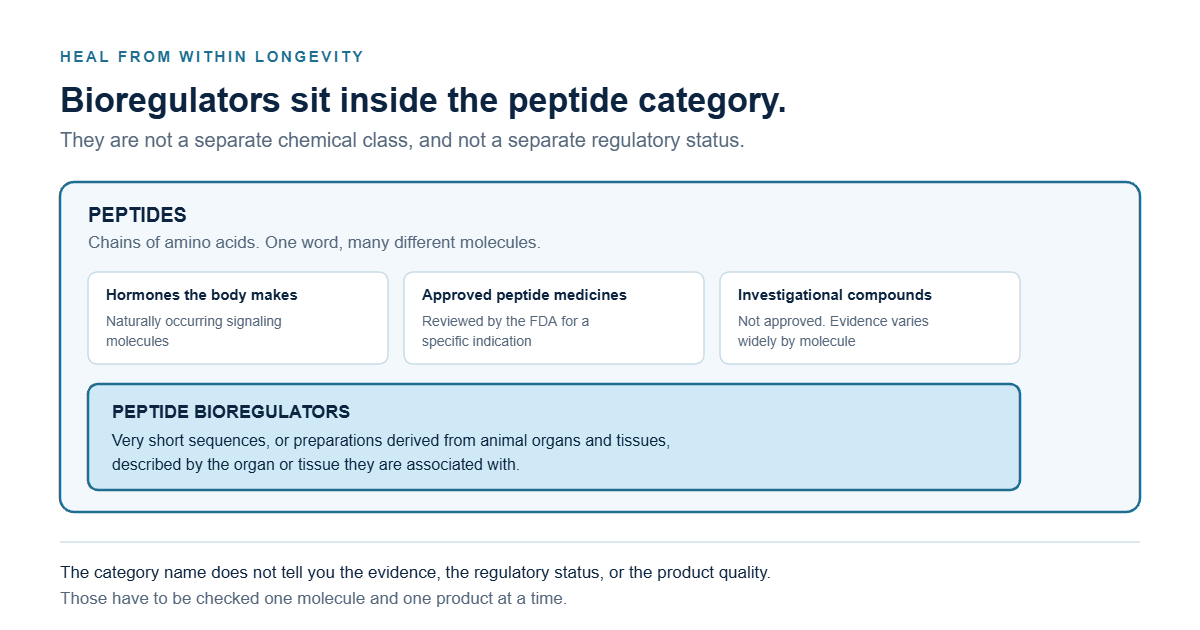
That may sound like semantics. It is not. When a category name carries assumptions such as natural, organ-specific, or safer, it can do more persuasive work than the evidence behind any individual product supports.
Start with the chemistry, not the marketing category
Peptides are chains of amino acids. The category is broad enough to include hormones the body makes, medicines that mimic or modify those hormones, peptides discovered in other natural sources, and sequences designed in a laboratory. Approved peptide medicines and investigational longevity compounds can share the same basic chemistry while differing completely in mechanism, evidence, manufacturing standard, and risk.1
Bioregulator is a different kind of word. It is not a general chemical definition and it is not a United States regulatory status. In the research tradition most associated with the term, investigators isolated peptide preparations from animal organs and tissues, then developed short synthetic analogues containing two, three, or four amino acids.2 Epithalamin, for example, refers to a pineal-derived preparation, while epitalon is a defined synthetic tetrapeptide associated with that same research line. One is an extract. The other is a specific sequence. Those are not the same kind of object, and a single category label covers both.
So the comparison is not like vitamin versus peptide, or drug versus supplement. It is closer to comparing a large category with one specialized lineage inside it.
What one word tells you, and what it does not
Both words describe what a molecule is. Neither answers the questions that decide whether a specific product is worth taking.
| Question | Peptides, the broad category | Peptide bioregulators, one family inside it |
|---|---|---|
| What the word describes | Any chain of amino acids | Very short sequences, or preparations derived from organs and tissues |
| Typical length | Anywhere from a few amino acids to several dozen | Commonly two to four amino acids, or an uncharacterized mixture |
| Origin | Naturally occurring, modified, recombinant, or fully synthetic | Tissue-derived preparation, or a synthetic analogue of one |
| What the name tells you about evidence | Nothing. It ranges from replicated trials to cell studies only | Nothing. It ranges from older human reports to preclinical work only |
| What the name tells you about United States regulatory status | Nothing. Some are approved drugs, many are not | Nothing. The term carries no regulatory meaning at all |
| What still has to be checked | The exact molecule or extract, the human outcome claimed, independent replication, the regulatory pathway, product identity and purity, and what will be monitored | |
What organ-specific does and does not mean
Bioregulators are usually organized around an organ or tissue: pineal, thymus, liver, vascular tissue, cartilage. That framing is what makes the category intuitively attractive. If a test result or a symptom points at one system, a matching product can look like a precise answer.
But associated with an organ can mean several different things, and they carry different weight. A preparation may have been extracted from that tissue. A short sequence may have been derived from peptides found there. Laboratory studies may show a real, measurable effect in a cell or animal model, which is a meaningful starting point and the reason this research continues. What none of those facts establishes on its own is that a product travels only to that organ, produces a clinically meaningful benefit in people, or changes how that organ ages.
The bioregulator literature proposes effects on gene expression and tissue-specific protein synthesis. Those mechanisms are active areas of investigation rather than a settled explanation that can be applied uniformly to every marketed product.24 Organ-specific is best read as a working hypothesis worth investigating. That is a real thing to have, and it is not the same as a guarantee printed into the molecule.
Three shortcuts that create confusion
Natural versus synthetic
Some products are tissue-derived peptide complexes, others are exact synthetic sequences, and conventional peptide medicines can also be naturally occurring, modified, recombinant, or fully synthetic.1 Source alone does not establish purity, potency, absorption, effectiveness, or safety.
Broad versus targeted
Many well-characterized peptides act at specific receptors, while a product described as a tissue bioregulator may contain several components that have not been individually identified. Molecular length does not tell you whether an effect will be narrow, clinically useful, or predictable.
Small versus safe
A very short peptide may be easier to synthesize, but fewer amino acids is not a safety grade. Route, stability, impurities, immune response, and product quality all still matter, and route matters more than most people expect. The FDA maintains a list of bulk drug substances that may present significant safety risks in compounding, and epitalon appears on it. The agency’s stated concern is specific: compounded drugs containing epitalon may pose a risk for immunogenicity for certain routes of administration, because of the potential for aggregation and peptide-related impurities, and the FDA says it has not identified safety information for the proposed route.5 That is a statement about a compounded injectable preparation, not about every product that shares the name. It is also an argument for reading the route, the formulation, and the regulatory pathway rather than the molecule alone.
What does the human evidence show?
There is a real scientific literature behind peptide bioregulators, and parts of it are genuinely interesting. Laboratory and animal studies report measurable biological effects, and there is a body of older human clinical work behind the category. What the field does not yet have is the independent replication, long-term safety data, and systematic dose-finding that would turn promising signals into established practice. Much of the work also comes from a concentrated research network associated with the field’s originators, which is a reason to look for outside confirmation rather than a reason to dismiss the findings.
One frequently cited 2003 publication followed 266 older adults and reported lower illness and mortality measures in groups receiving the thymic preparation Thymalin, the pineal preparation Epithalamin, or both.3 The reported differences are substantial, and they are a large part of why this category continues to attract serious research attention. They are also the reason to be careful with it. The published abstract does not report randomization, blinding, or allocation, and an effect of that size is exactly the kind of finding that calls for rigorous independent replication before anyone treats it as settled. Data suggesting a potential benefit and proof of one are different things, and this is the first.
A 2026 review of therapeutic peptides in gerontology reached a balanced conclusion. Non-approved peptides may have promising preclinical or limited clinical evidence, while independent validation, long-term safety data, systematic dose-finding, and reliable monitoring biomarkers remain important gaps.4 That describes the field better than either proven anti-aging therapy or no science at all.
Regulatory status belongs in the comparison
Peptide does not mean approved, and bioregulator does not mean exempt from scrutiny. Some peptide drugs have gone through extensive development and FDA review for a specific indication. Many compounds discussed in longevity settings have not.
The formulation matters as much as the molecule. FDA-approved, compounded, dietary supplement, and research-use products are not interchangeable labels. The FDA states that compounded drugs are not FDA-approved and are not reviewed before marketing for safety, effectiveness, or quality.6 Compounding can serve a legitimate medical need. That does not make a compounded product equivalent to an approved one.
This is why asking only whether something is a peptide or a bioregulator is too shallow a question. The more useful one is what exactly the product is, and which legal and evidentiary pathway applies to it.
Where testing helps, and where it can overreach
Symptoms, history, medications, standard laboratory findings, metabolic and hormonal patterns, sleep, recovery, and nutrition can reveal that the first priority is not a peptide at all. Correcting a deficiency or clarifying a diagnosis often matters more than adding another signal on top of an unresolved problem.
Biological-age and organ-system reports add a research-oriented lens that conventional panels do not, and they are useful for organizing questions and surfacing patterns worth investigating. What they should not be used as is a product-matching engine. In geroscience, a biomarker can correlate with risk, or shift after an intervention, without being a validated stand-in for a meaningful health outcome.7 Recent critiques also caution that epigenetic clocks do not yet meet the standard required to direct an individual person’s treatment decisions.8
A high organ-age estimate is not proof that a matching bioregulator is needed. It is a prompt to compare that signal against conventional clinical data, understand the uncertainty, and decide whether any action is justified at all.
How HFW decides whether a peptide or bioregulator is appropriate
Heal From Within Longevity is a clinician-led longevity and health optimization practice in Hillsdale, New Jersey, with physician medical direction. Advanced compounds are one possible tool inside a monitored plan, never the starting point. The sequence is the same regardless of which category a product falls into.
Discover
Build the clinical picture first: history, symptoms, medications, conventional bloodwork, and advanced testing where a result would change a decision. The point is to establish what problem is actually being solved before any product is discussed.
Correct
Address what is measurably off and what is reachable: sleep, nutrient status, blood sugar, gut function, inflammation, stress load, hormones. Starting at the top of the menu often means paying for an intervention that cannot work yet.
Optimize
Consider a selected therapy only when the foundation supports it and there is a defined objective. HFW works with this category because the underlying research is interesting enough to take seriously and because patients ask about it, and the commitment that comes with that is to be straight about what is and is not known. HFW treats current oral bioregulator products commercially like retail supplements rather than as prescription therapies, and says so plainly rather than implying a clinical status the evidence does not yet carry.
Monitor
Agree in advance on what is tracked, over what period, and what finding would change or stop the plan. A therapy with no stopping rule is not a plan.
Seven questions to ask about either category
- What exactly is in the product: one defined sequence, a peptide complex, or an extract?
- What human outcome is being claimed, and was that outcome actually measured?
- Does the evidence come from cells, animals, a small human study, or replicated controlled trials?
- Was the result reproduced by investigators independent of the product’s developers?
- What is the current United States regulatory status for this ingredient, formulation, route, and proposed use?
- How are identity, purity, sterility, storage, and chain of custody verified?
- What will be monitored, over what time frame, and what finding would make the plan change or stop?
If a seller cannot answer those seven, the category label will not rescue the decision.
The bottom line
Bioregulators are not the opposite of peptides. They are a smaller, historically specific branch of the same conversation, with a research history worth taking seriously and an evidence base that is still developing. That distinction can be useful. It should never substitute for examining the exact compound, the quality of the human evidence, the regulatory status, the product controls, and the measurable goal.
The better first question is rarely which category to take. It is what problem is being solved, how certain anyone is that it is the right problem, and what evidence would justify this particular tool. Sometimes the answer includes a peptide. Sometimes it includes a bioregulator. Sometimes the most precise decision is to use neither.
Frequently asked questions
Are bioregulators the same thing as peptides?
They are a subset. Peptide bioregulators are peptides, but most peptides are not called bioregulators. The label describes a particular family of very short sequences and tissue-derived preparations discussed in terms of organ association. It does not place a product in a separate chemical or regulatory category.
Are bioregulators safer than peptides because they are smaller?
Size is not a safety grade. A shorter sequence may be easier to manufacture, but route of administration, stability, impurities, immune response, and product quality still determine risk. Safety has to be evaluated for the specific product and the specific person, not inferred from the category.
Are bioregulators FDA approved?
The term bioregulator carries no FDA status. HFW treats current oral bioregulator products commercially like retail supplements, and supplements are not FDA approved as drugs. Compounded preparations are a separate category again, and the FDA states that compounded drugs are not FDA-approved and are not reviewed before marketing for safety, effectiveness, or quality.
Can bioregulators reverse aging or regenerate organs?
No. Some of the research is genuinely interesting and reports real biological effects, which is why the category is worth following. None of it is strong enough to promise a clinical outcome, and HFW does not claim age reversal, organ regeneration, cancer prevention, or a longer life.
Does a high organ age on a biological age test mean I need a matching bioregulator?
No. A biological-age or organ-system estimate is a research-oriented signal, not a validated companion diagnostic. It can generate a question worth investigating. It cannot select a product, and it should be read alongside conventional clinical data rather than in place of it.
Does HFW publish peptide or bioregulator dosing?
No. Dosing is an individualized clinical decision that depends on the person, the product, the route, and the monitoring plan. HFW does not publish dosing, schedules, or sourcing instructions, and products labeled research use only should not be used for self-treatment.
How do I evaluate a bioregulator product someone is selling me?
Ask what exactly is in it, what human outcome is claimed and whether it was measured, whether anyone independent reproduced the result, what the United States regulatory status is for that formulation and route, and how identity and purity are verified. A seller who cannot answer those has not given you enough to decide on.
Does everyone at HFW need a peptide or a bioregulator?
No. Many plans never include either. Foundations such as sleep, nutrition, training, metabolic health, and correcting what testing shows is measurably off come first, and sometimes the most precise recommendation is not to add another product at all.
References
- Wang L, Wang N, Zhang W, et al. Therapeutic peptides: current applications and future directions. Signal Transduction and Targeted Therapy. 2022;7:48. Peer-reviewed review of peptide drug development across natural, modified, recombinant, and synthetic agents.
- Anisimov VN, Khavinson VK. Peptide bioregulation of aging: results and prospects. Biogerontology. 2010;11(2):139-149. Review by originators of the bioregulator research program, summarizing tissue-derived preparations and short synthetic analogues; much of the evidence described is preclinical.
- Khavinson VK, Anisimov VN. Peptides of pineal gland and thymus prolong human life. Neuro Endocrinology Letters. 2003;24(3-4):233-240. Human comparative study of 266 older adults; the abstract does not report randomization, blinding, or allocation.
- Mavrych V, Shypilova I, Bolgova O. Therapeutic peptides in gerontology: mechanisms and applications for healthy aging. Frontiers in Aging. 2026;7:1790247. Peer-reviewed mini-review describing gaps in independent validation, long-term safety, and dose-finding for non-approved peptides.
- U.S. Food and Drug Administration. Certain bulk drug substances for use in compounding that may present significant safety risks. Regulatory record listing substances with identified quality or safety concerns in compounding.
- U.S. Food and Drug Administration. Understanding the risks of compounded drugs. FDA guidance stating that compounded drugs are not FDA-approved and are not reviewed before marketing.
- Cummings SR, Kritchevsky SB. Endpoints for geroscience clinical trials: health outcomes, biomarkers, and biologic age. GeroScience. 2022;44(6):2925-2931. Methods article on why a change in biological age is not yet a validated surrogate for clinical benefit.
- Apsley AT, Etzel L, Ye Q, Shalev I. From population science to the clinic? Limits of epigenetic clocks as personal biomarkers. Epigenomics. 2025;17(18):1447-1461. Peer-reviewed perspective on the limits of epigenetic clocks for individual decisions.
Related reading
- Is peptide therapy evidence-based?
- Are peptides safe?
- How accurate are biological age tests?
- Bioregulator therapy at HFW
Written by the HFW clinical team. Medically reviewed by Christina Warner, APN-C on September 11, 2026.
Testing is generally available nationwide. The exact treatment service depends on the patient’s state, clinician authorization, laboratory rules, pharmacy requirements, and the therapy involved.
This article is educational and does not provide individualized medical advice. It does not establish a clinician-patient relationship. Individual questions about your own health belong with an HFW advanced care clinician or your own physician. If you are experiencing a medical emergency, call 911 or go to your nearest emergency department.
Schedule a complimentary introductory call with an HFW advanced care clinician.