
Fatigue, weight gain, low libido and brain fog can be measurable clues. The answer is not to dismiss them as aging or to assume testosterone is the cause. It is to test the full picture.
Medically reviewed by Christina Warner, APN-C. Updated September 19, 2026.
At least eight common conditions produce the same cluster in men over 40: fatigue, weight gain around the middle, lower drive, slower recovery and difficulty concentrating. Testosterone is one of them. The symptoms cannot distinguish between them, which is why the useful question is not what is causing this but what testing would tell them apart.
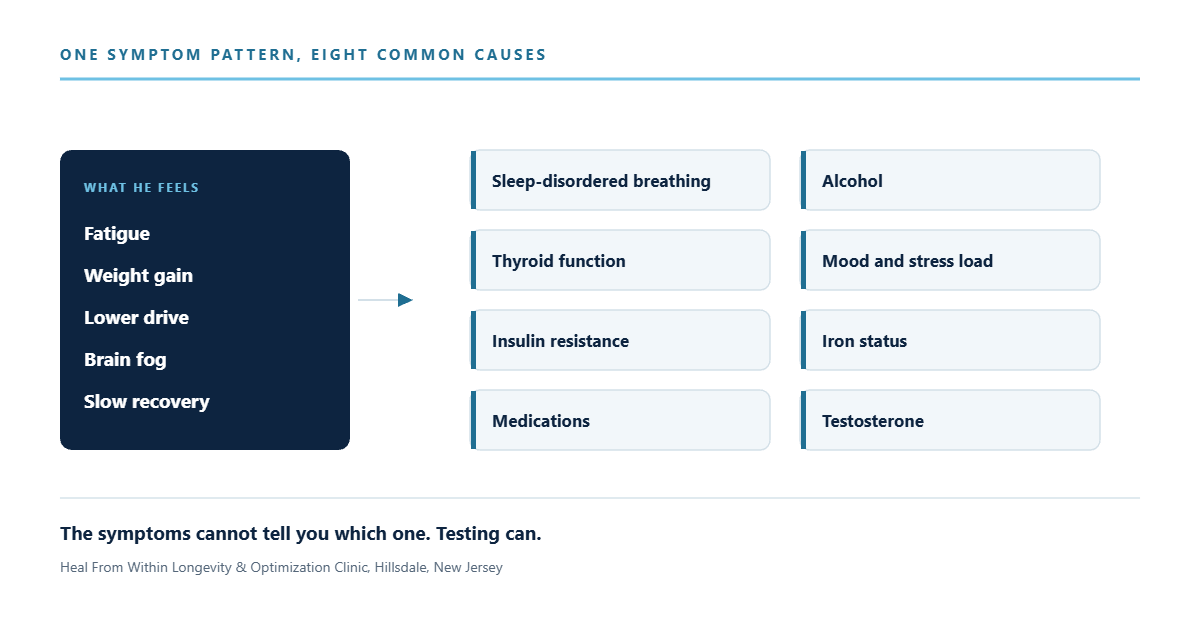
The symptoms are real. The cause is the open question.
Something changed. The workout that used to clear your head now flattens you. Weight settles around your middle on habits that have not moved much. Your attention drifts, your patience is shorter, and sex is easier to postpone than to start.
The common response is to call it aging. The second most common response, increasingly, is to call it testosterone. Both skip a step. These symptoms are produced by a short list of conditions that are individually treatable and that look nearly identical from the outside.
What else produces this exact pattern
Each of the following is common in men over 40, produces overlapping symptoms, and is distinguishable by testing rather than by how it feels.
Sleep-disordered breathing
Untreated sleep apnea fragments sleep without waking a man fully, so the days feel heavy while the nights feel unremarkable. It becomes more likely with weight gain and with age, and it is associated with lower testosterone, which means it can look like a hormone problem while being a breathing problem.
Thyroid function
An underactive thyroid produces fatigue, weight gain, low mood, cold intolerance and slowed thinking. A basic panel does not always include the full picture, and thyroid results are frequently interpreted against a population range rather than against the man’s own symptoms and history.
Insulin resistance and metabolic health
Rising insulin resistance produces post-meal energy crashes, central weight gain and difficulty losing fat on the same effort that used to work. It also suppresses the signaling system that regulates testosterone production, so metabolic dysfunction and low testosterone frequently arrive together and the order matters for the plan.
Medications
Opioids and corticosteroids can lower testosterone directly. Several other common classes affect energy, mood, sexual function or sleep quality. A medication review is one of the cheapest and most productive parts of an evaluation, and it is regularly skipped.
Alcohol
Regular evening alcohol degrades sleep architecture even when total sleep time looks normal, affects liver function and mood, and interacts with the hormonal system. The amount that produces this is often lower than men expect and is frequently not disclosed unless it is asked about directly.
Mood and stress load
Depression in midlife men often presents as irritability, withdrawal, loss of interest and fatigue rather than sadness, which is part of why it goes unnamed. It overlaps almost completely with the low testosterone symptom list, and the two can also coexist.
Iron status
Iron deficiency causes fatigue and exercise intolerance before it causes anemia, so a normal hemoglobin does not settle it. Ferritin is not on most standard panels and is worth measuring when fatigue is the leading complaint.
Under-recovery
Training volume that outpaces recovery produces flat performance, poor sleep, low motivation and reduced libido. It is the one item on this list that improves with doing less, which is why it is worth identifying before anything is prescribed.
Testosterone
Genuinely low testosterone can produce reduced sexual desire, fewer morning erections, loss of muscle and strength, increased body fat and lower physical vigor. Testosterone also changes gradually across midlife, with wide variation between men, and weight change and lifestyle modify that pattern.1
| Possible contributor | What makes it more likely | What usually clarifies it |
|---|---|---|
| Sleep-disordered breathing | Snoring, weight gain, unrefreshing sleep, morning headache | A sleep assessment |
| Thyroid dysfunction | Cold intolerance, dry skin, constipation, slowed thinking | A full thyroid panel |
| Insulin resistance | Central weight gain, post-meal crashes, family history | Fasting insulin and glucose markers |
| Medication effect | Symptoms began after a new prescription | A structured medication review |
| Alcohol | Regular evening drinking, poor sleep quality | An honest intake history |
| Mood disorder | Irritability, withdrawal, loss of interest | A validated screening conversation |
| Iron deficiency | Fatigue out of proportion to effort, exercise intolerance | Ferritin and iron studies |
| Low testosterone | Reduced libido, fewer morning erections, loss of strength | Repeated morning testosterone, with free testosterone and SHBG when indicated |
More than one of these is often present at the same time, which is the main reason a single explanation tends to disappoint.
If it is testosterone, one result will not settle it
The Endocrine Society defines hypogonadism through two findings together: symptoms consistent with deficiency, and testosterone that is consistently low on properly timed, repeated measurement. Its July 2026 statement is explicit that symptoms alone are not diagnostic.23
Confirming a low level is the beginning of the question rather than the end of it. Our companion article on the signs of low testosterone covers the measurement conditions, what SHBG and free testosterone add, and how the evaluation separates a testicular problem from reduced signaling above it.
What treating it does and does not fix
This is where expectations need to be set honestly. In a randomized placebo-controlled trial of 790 men aged 65 and older with low testosterone and relevant symptoms, treatment significantly improved sexual desire, erectile function and sexual activity, and modestly improved mood and depressive symptoms. It showed no benefit for vitality as measured by a validated fatigue scale.4
That trial studied men older than the reader this article is written for, so it does not transfer directly. It is still the best randomized evidence available, and the direction of the finding matters: the symptom most men come in describing, which is energy, is the one with the weakest evidence of response. Regulatory framing points the same way. FDA continues to limit approved testosterone use to men with low testosterone associated with a medical condition, and its 2025 class-wide labeling update added a warning about increased blood pressure.5
How HFW works through a pattern like this
Heal From Within is a clinician-led longevity and health optimization practice in Hillsdale, New Jersey, with physician medical direction. For a man presenting with this cluster, the sequence is deliberate.
Discover
A specific history first: what changed, when, how sleep and recovery shifted, what medications and alcohol are in the picture, and whether fertility is a current or future priority. Then testing chosen to separate the branches above, rather than a single hormone panel.
Correct
Where a contributor is reversible, it is addressed first. Untreated sleep-disordered breathing, iron deficiency, thyroid dysfunction, a medication effect and metabolic disease are all capable of producing this picture, and correcting them sometimes changes the conclusion entirely.
Optimize
Therapy is considered when the data support it, evaluated and prescribed by an authorized HFW prescriber after fertility, cardiovascular, prostate and hematologic review. It is one tool inside a monitored plan, not the plan.
Monitor
Response is measured against the symptoms and markers that mattered at the start, on a defined schedule, with the plan changed when the results change. The least intervention reasonably necessary, reassessed rather than assumed permanent.
What would change the plan
These are the questions that move an evaluation forward, and they are worth asking of any clinician.
- Which of the eight common contributors have actually been measured, and which were assumed?
- Was my sleep assessed, or only asked about?
- Were hormone levels drawn in the morning, and repeated?
- Does my medication list include anything known to affect energy, mood or hormones?
- If one contributor is corrected, what should improve, and by when?
- What result would tell us the plan is not working?
Feeling different after 40 is not proof of decline, and it is not proof of a hormone problem. It is a pattern with a short list of testable explanations, and the work is telling them apart before anything is treated.
Frequently asked questions
Is low energy after 40 always low testosterone?
No. Sleep-disordered breathing, thyroid dysfunction, insulin resistance, medication effects, alcohol, mood disorders, iron deficiency and simple under-recovery all produce a similar picture. Testosterone is one branch of the differential, not the default explanation, and the symptoms themselves cannot tell you which one you are looking at.
My routine blood work was normal. Does that rule everything out?
It rules out what was measured. A standard panel typically does not include thyroid antibodies, fasting insulin, sex hormone-binding globulin, free testosterone, ferritin or a sleep assessment. A normal result on a narrow panel is a reason to ask what else is worth measuring, not a reason to stop.
Can sleep apnea cause fatigue, weight gain and low libido?
Untreated sleep-disordered breathing can produce all three, and it becomes more common in men after 40, particularly with weight gain. It is also associated with lower testosterone, which is part of why treating the sleep problem sometimes changes the hormone picture without any hormone treatment at all.
Does testosterone drop suddenly at 40?
Usually not. Longitudinal research describes a gradual and highly variable change across midlife, and shows that weight change and lifestyle modify the pattern. Age is involved but is not acting alone, so age by itself does not explain an individual man’s result.
If my testosterone is low, will treating it fix my energy?
Not reliably. In a randomized trial of 790 men aged 65 and older with low testosterone, treatment improved sexual function and modestly improved mood, but showed no benefit for vitality as measured by a validated fatigue scale. A corrected laboratory value does not guarantee that every symptom resolves.
What should a proper evaluation include?
A specific symptom history, a sleep and medication review, metabolic and thyroid assessment, iron status, and hormone measurement taken under appropriate conditions and repeated before anything is concluded. The point is to gather what can change a decision rather than to order every test available.
Does HFW publish testosterone dosing?
No. Dosing and monitoring intervals are individual clinical decisions made by an authorized HFW prescriber after evaluation. We do not publish them as education.
References
- Camacho EM, et al. Age-associated changes in hypothalamic-pituitary-testicular function in middle-aged and older men are modified by weight change and lifestyle factors. Eur J Endocrinol. 2013. European Male Ageing Study, a longitudinal cohort.
- Endocrine Society. Statement on Testosterone Replacement Therapy (July 16, 2026). Professional society statement on diagnostic standards.
- Bhasin S, et al. Testosterone Therapy in Men With Hypogonadism: An Endocrine Society Clinical Practice Guideline. J Clin Endocrinol Metab. 2018. Guideline covering diagnosis and measurement.
- Snyder PJ, et al. Effects of Testosterone Treatment in Older Men. N Engl J Med. 2016;374:611-624. The Testosterone Trials, a randomized placebo-controlled trial in 790 men aged 65 and older.
- U.S. Food and Drug Administration. FDA issues class-wide labeling changes for testosterone products (February 28, 2025). Regulatory action revising cardiovascular and blood pressure labeling.
Related reading
- What are the signs of low testosterone?
- Can a gut infection cause low testosterone and brain fog?
- How HFW practices functional medicine
- Advanced health testing
Written by the HFW clinical team. Medically reviewed by Christina Warner, APN-C on September 19, 2026.
Testing is generally available nationwide. The exact treatment service depends on the patient’s state, clinician authorization, laboratory rules, pharmacy requirements, and the therapy involved.
This article is educational and does not provide individualized medical advice. It does not establish a clinician-patient relationship. Individual questions about your own health belong with an HFW advanced care clinician or your own physician. If you are experiencing a medical emergency, call 911 or go to your nearest emergency department.
Schedule a complimentary introductory call with an HFW advanced care clinician.