
The same stool sample, seven different answers.
Medically reviewed by Dr. Eric Landi, KICP, DC. Updated September 8, 2026.
It depends which kind of test. When researchers sent standardized human fecal material to seven direct-to-consumer gut microbiome services, the reports disagreed as much between companies as samples from different donors disagreed with each other.1 Clinician-ordered targeted panels, run in certified laboratories to answer a defined question, are a different category and were not what that study evaluated.
What the seven-provider comparison actually found
Researchers at the National Institute of Standards and Technology evaluated seven direct-to-consumer gut microbiome testing services using a standardized human fecal material developed for exactly this purpose. Because every service received material of known and identical composition, any disagreement between their reports came from the testing, not from the sample.1
The reports did not simply describe the same finding in different words. The study reported major discrepancies both within and across providers, and found that variability between providers was on the same scale as biological variability between different donors. The authors attributed the differences to methodological variability and a lack of sufficient quality control, and concluded that analytical performance is a prerequisite for making sound clinical recommendations.1
That finding does not mean the gut microbiome is imaginary, or that every stool test is worthless. It means something more useful and more specific: the science of the microbiome and the clinical interpretation of a commercial microbiome report are not the same thing.
Direct-to-consumer is not the same as collected at home
The study evaluated direct-to-consumer services, meaning tests a consumer buys directly, with no clinician deciding that the test was indicated and no clinician receiving the result. The report goes back to the buyer, often as a score or a dashboard.
That is a different thing from where the sample is collected. Almost all stool testing is collected at home, including panels a clinician orders. Collecting a sample in your own bathroom is not what makes a test direct-to-consumer. What matters is whether a clinician decided the test was worth running, and whether a clinician is responsible for reading the result against your history.
A clinician-ordered panel run in a laboratory certified under the Clinical Laboratory Improvement Amendments is a different category from a mail-order wellness profile. That does not make any single test correct. It means the seven-provider finding should not be stretched to cover tests it did not examine.
The microbiome is real. The universal score is not.
Researchers have linked features of the gut microbial community with metabolism, immune activity, gastrointestinal disease, and medication response. A link found across groups does not tell us what one person’s result means, what caused it, or how it should be treated.
There is no universally accepted definition of an ideal healthy microbiome. Two healthy people can have meaningfully different microbial communities. Results are also influenced by diet, medications, geography, age, stool consistency, collection, shipping, laboratory processing, and the reference database used to classify organisms.
An international multidisciplinary expert panel examined this gap in a consensus statement published in The Lancet Gastroenterology & Hepatology. The panel noted that evidence supporting the clinical usefulness of microbiome testing is scarce, that an increasing number of commercial providers offer direct-to-consumer tests without consensus on regulation or proven value in clinical practice, and that this can waste individual and health-care resources and create drawbacks in patient management.2 A polished dashboard can look more clinically settled than the science beneath it.
Not every stool test is the same test
“Microbiome test” has become a catch-all phrase for tools that do very different jobs, and treating them as interchangeable is where most of the confusion starts.
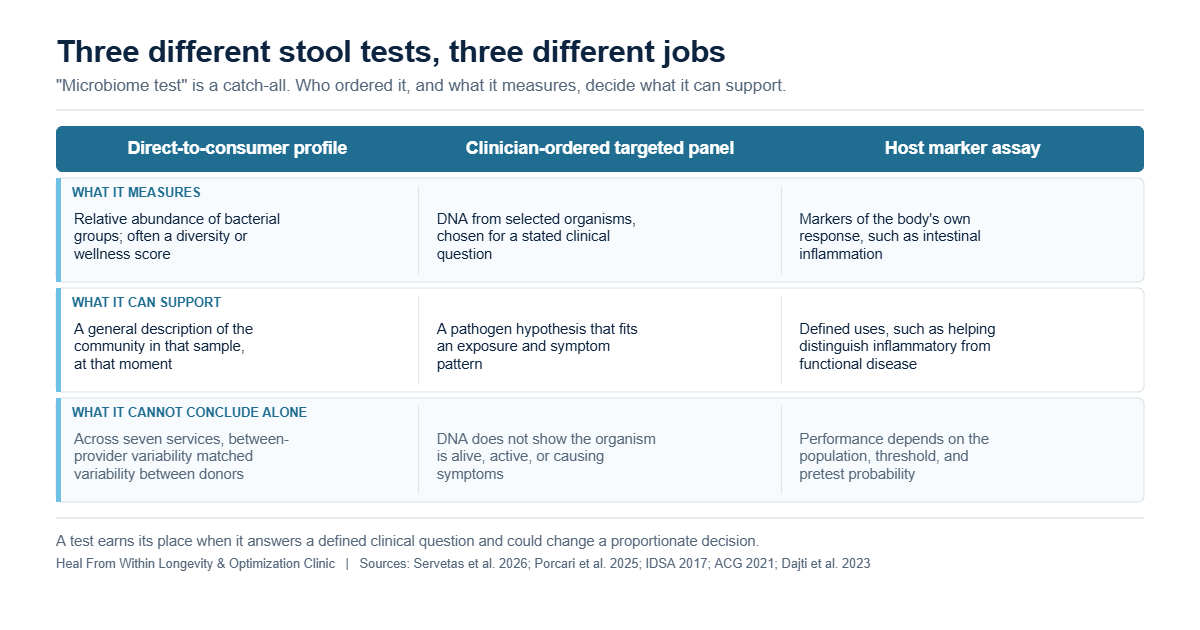
A direct-to-consumer sequencing service describes the relative abundance of bacterial groups and often generates a diversity or wellness score. A clinician-ordered targeted panel looks for DNA associated with selected organisms. Other stool assays measure host markers, such as intestinal inflammation or digestive function, rather than attempting to grade the entire microbial ecosystem.
Some targeted markers have established uses. The American College of Gastroenterology suggests checking fecal calprotectin in patients with suspected irritable bowel syndrome and diarrhea symptoms in order to rule out inflammatory bowel disease.4 A 2023 systematic review and meta-analysis of 17 studies covering 1,956 patients found fecal calprotectin had a summary sensitivity of 85.8 percent and a specificity of 91.7 percent for distinguishing inflammatory bowel disease from irritable bowel syndrome.5
Even a well-validated marker has to be read in context. In that same analysis, with inflammatory bowel disease prevalence modeled at 1 percent, the negative predictive value was 99.8 percent while the positive predictive value was only 9 percent.5 A reassuring result was highly informative. A flagged result, where the disease is uncommon, warranted a closer look rather than a conclusion. That is the arithmetic behind treating a single abnormal value as a starting point.
Detection is a finding, not a diagnosis
Molecular detection carries a built-in interpretive limit. A test can identify microbial DNA without showing that the organism is alive, active, or responsible for the symptoms that prompted the test. Guidance from the Infectious Diseases Society of America recommends interpreting multiplex nucleic-acid results in clinical context rather than treating a positive signal as a self-contained answer.3
Detection is a finding. Causation is a conclusion, and reaching it usually takes more evidence than one line on a report.
The most common mistake is treating the report instead of the patient
Long reports create pressure to act. A bacterium is marked high, another low, a diversity score turns red, and a person leaves with a restrictive diet, several supplements, and an antimicrobial plan. If the underlying finding is unstable, poorly standardized, or unrelated to the symptoms, a more elaborate protocol is not more personalized. It is simply more elaborate.
Overinterpretation carries real costs. People may eliminate nutritious foods, take products they do not need, or delay evaluation for celiac disease, inflammatory bowel disease, medication effects, pelvic-floor dysfunction, or motility disorders. Testing can also create a loop in which every follow-up report generates another intervention with no clear endpoint.
A serious functional medicine approach should be able to explain not only why a test is being ordered, but also what the clinician will decline to infer from it.
Five questions to ask before you pay for a gut test
| Ask this | What a good answer sounds like |
|---|---|
| What exact clinical question is this test meant to answer? | A named symptom pattern or a specific decision. “Gut health” is too broad to be an answer. |
| What does the assay measure, and how well is that measurement validated? | Sequencing composition, detecting selected DNA targets, and measuring inflammation are different tasks with different evidence behind them. |
| What would change if the result came back positive, negative, or unclear? | Three different next steps. If every result leads to the same supplements, the test is not doing decision work. |
| What will you refuse to conclude from this report? | Presence is not infection, association is not causation, and a proprietary score is not a diagnosis. |
| Has conventional evaluation been considered, and have warning signs been ruled out? | A clear account of what standard workup has or has not been done, and why testing is the right next step now. |
Blood in the stool, black stool, unintended weight loss, symptoms beginning later in life, or a significant family history can change the appropriate pathway entirely.4 A wellness report should never delay indicated medical evaluation or routine colorectal cancer screening.
How Heal From Within approaches gut testing
Heal From Within is a clinician-led longevity and health optimization practice based in Hillsdale, New Jersey, with physician medical direction. In gut care the sequence is Discover, Correct, Optimize, and Monitor, and testing sits inside that sequence rather than starting it.
Discover
Discovery does not mean ordering the broadest panel available. It means clarifying the pattern first: symptoms, duration, triggers, medications, travel or infection history, dietary changes, and prior evaluation.
Correct
A result is reconciled with the symptoms and the rest of the clinical picture before anything is acted on. HFW does not treat every detected organism. The least burdensome reasonable intervention comes first, with a defined way to judge whether it helped.
Optimize
Optimization follows correction rather than replacing it. Sleep, nutrition, fiber, stress load, activity, and medication review often carry more weight than any single organism on a report.
Monitor
Retesting makes sense when the new result could guide the next decision, not because another interval has passed. A test with no stopping rule tends to generate more testing.
The value is not in how much the test can print
Microbiome science is moving quickly and better validated applications are likely to emerge, so skepticism should not harden into dismissal. The most useful gut assessment is still not the one that identifies the largest number of organisms. It is the one chosen for a defensible reason, interpreted alongside the patient’s history, and tied to a proportionate action and a stopping rule. That is the difference between collecting health data and practicing personalized medicine.
Frequently asked questions
Are direct-to-consumer gut microbiome tests accurate?
A 2026 evaluation of seven direct-to-consumer gut microbiome services using standardized human fecal material found major discrepancies within and across providers, with between-provider variability on the same scale as biological variability between different donors. The authors attributed this to methodological variability and insufficient quality control. Broad direct-to-consumer profiling should not be treated as a settled measurement.
Is a test collected at home the same as a direct-to-consumer test?
No. Almost all stool testing is collected at home, including panels ordered by a clinician. Direct-to-consumer describes who bought the test and who receives the result, not where the sample was produced. A test a clinician ordered for a stated reason and reads against your history is a different category from a kit bought online that returns a score to the buyer.
What is the difference between a microbiome profile and a stool pathogen panel?
A microbiome profile describes the relative abundance of bacterial groups across the whole community and often produces a diversity or wellness score. A targeted molecular panel looks for DNA from selected organisms and is generally ordered by a clinician for a defined question. They answer different questions, carry different evidence, and should not be treated as interchangeable.
Does finding an organism on a stool test mean it is causing my symptoms?
No. A molecular test can detect microbial DNA without showing that the organism is alive, active, or responsible for symptoms. Infectious disease guidance recommends interpreting multiplex nucleic-acid results in clinical context. Detection is a finding; causation is a conclusion that usually requires more evidence.
Is there such a thing as a healthy microbiome score?
There is no universally accepted definition of an ideal healthy microbiome, and two healthy people can have meaningfully different microbial communities. A proprietary score reflects one company’s method and reference database. It is not a standardized clinical measurement and it is not a diagnosis.
Can a gut test diagnose IBS or inflammatory bowel disease?
No single stool test diagnoses either condition on its own. Fecal calprotectin is suggested in patients with suspected irritable bowel syndrome and diarrhea symptoms to help rule out inflammatory bowel disease, but the result is interpreted alongside symptoms, history, bloodwork, risk, and sometimes endoscopy. Diagnosis belongs with a licensed clinician who has evaluated you.
When should you see a doctor instead of ordering a test?
Blood in the stool, black stool, unintended weight loss, symptoms that begin later in life, or a significant family history warrant medical evaluation rather than a consumer test. Severe, rapidly worsening, or potentially life-threatening symptoms require urgent or emergency care. A wellness report should never delay indicated evaluation or routine colorectal cancer screening.
What testing does HFW use for gut symptoms?
HFW orders targeted stool and bloodwork testing through certified laboratories when it answers a specific clinical question and the result is likely to change a decision. Selection depends on symptoms, duration, medications, history, prior evaluation, and safety considerations. Ordering a larger panel is not the goal, and conventional evaluation is preserved rather than replaced. The gut health page sets out which tests HFW uses and what each one is for.
References
- Servetas SL, Gierz KS, Hoffmann D, Ravel J, Jackson SA. Evaluating the analytical performance of direct-to-consumer gut microbiome testing services. Communications Biology. 2026;9(1):269. The NIST-led analytical comparison of seven consumer gut microbiome services using standardized human fecal material.
- Porcari S, Mullish BH, Asnicar F, et al. International consensus statement on microbiome testing in clinical practice. The Lancet Gastroenterology & Hepatology. 2025;10(2):154-167. An international multidisciplinary expert panel on the clinical use, limits, and regulation of microbiome testing.
- Shane AL, Mody RK, Crump JA, et al. 2017 Infectious Diseases Society of America Clinical Practice Guidelines for the Diagnosis and Management of Infectious Diarrhea. Clinical Infectious Diseases. 2017;65(12):e45-e80. The professional guideline covering interpretation of molecular stool testing in clinical context.
- Lacy BE, Pimentel M, Brenner DM, et al. ACG Clinical Guideline: Management of Irritable Bowel Syndrome. The American Journal of Gastroenterology. 2021;116(1):17-44. The American College of Gastroenterology guideline covering diagnostic strategy, fecal calprotectin, and alarm features.
- Dajti E, Frazzoni L, Iascone V, et al. Systematic review with meta-analysis: Diagnostic performance of faecal calprotectin in distinguishing inflammatory bowel disease from irritable bowel syndrome in adults. Alimentary Pharmacology & Therapeutics. 2023;58(11-12):1120-1131. The meta-analysis of 17 studies and 1,956 patients reporting sensitivity, specificity, and predictive values.
Related reading
- Can a gut infection cause low testosterone and brain fog?
- Gut health and digestive dysfunction at HFW
- Advanced health testing: what HFW measures and why
- How accurate are biological age tests?
- Frequently asked questions about GI-MAP and gut testing
Written by the HFW clinical team. Medically reviewed by Dr. Eric Landi, KICP, DC on September 8, 2026.
Testing is generally available nationwide. The exact treatment service depends on the patient’s state, clinician authorization, laboratory rules, pharmacy requirements, and the therapy involved.
This article is educational and does not provide individualized medical advice. It does not establish a clinician-patient relationship. Individual questions about your own health belong with an HFW advanced care clinician or your own physician. If you are experiencing a medical emergency, call 911 or go to your nearest emergency department.
Schedule a complimentary introductory call with an HFW advanced care clinician.