
The symptom is real. It may not be the starting point.
Medically reviewed by Christina Warner, APN-C. Updated September 10, 2026.
Sometimes, but the connection has to be shown rather than assumed. An intestinal infection, or the state it leaves behind, can sit upstream of changes in digestion, immune activity, energy, hormone signaling, and thinking. In many other people the gut finding is incidental, already resolved, or one factor among several. The clinical question is not whether the gut can do this. It is whether it is doing it in you.
An infection can end while its effects continue
The intestinal tract is a major interface between the outside environment and the immune system, and it communicates continuously with the nervous and endocrine systems. An enteric infection can alter motility, mucosal immune activity, barrier function, appetite, sleep, and the composition of the gut ecosystem. Those effects are not equal in every person, and many infections resolve without lasting consequences.
But post-infectious illness is not theoretical. A 2024 systematic review and meta-analysis of 47 studies covering 28,170 adults found that 14.5% developed post-infection irritable bowel syndrome and 12.7% developed post-infection functional dyspepsia after acute gastroenteritis. People who had an episode of acute gastroenteritis had roughly four times the odds of IBS and three times the odds of functional dyspepsia compared with unexposed controls.1
Two details in that analysis are worth carrying forward. Among people who developed post-infection IBS, symptoms were still present in 39.8% of those followed beyond five years, so this is not always a short chapter. And the highest post-infection IBS prevalence, 30.1%, followed parasitic infection, but that figure rested on only two studies, which is exactly the kind of number that gets repeated online without its caveat.1
So a durable gut consequence after infection is well supported. That is a different claim from saying every later symptom comes from a persistent organism, or that every positive stool result needs to be eradicated.
Why testosterone can move with the rest of the system
Hormones respond to illness. In men, the hypothalamic-pituitary-gonadal axis can be suppressed during acute and critical illness, and testosterone can fall as inflammatory and stress signals rise. A 2025 review examines how that axis is modified under critical conditions and how those changes affect illness course and treatment outcomes.2
Read the boundary of that evidence carefully. It is drawn from severe systemic illness. It does not establish that an ordinary or long-past gut infection explains chronic low testosterone in a particular person, and anyone telling you it does has gone past what the research shows.
Low testosterone also travels with sleep disruption, energy deficit, excess body weight, certain medications, pituitary or testicular conditions, and other medical problems. That is why one low value is not a diagnosis. Endocrine Society guidance is specific about this: make the diagnosis only in men who have both symptoms and consistently low testosterone, measure fasting morning total testosterone with a reliable assay, confirm it by repeating that measurement, and then evaluate what is causing it.3
Notice that the guideline builds in the same sequence this article is arguing for. Confirm the finding, then look for the cause, and only then decide about treatment.
“Brain fog” is a description, not a mechanism
Systemic infection and inflammation can impair mental function through changes in attention and cognition, and post-infectious conditions such as myalgic encephalomyelitis and chronic fatigue syndrome show how immune, vascular, metabolic, and neurologic processes can overlap. The proposed mechanisms in that literature, including low-grade persistent inflammation and altered regional cerebral blood flow, remain uncertain.4
That evidence is also indirect for routine intestinal infection. And the same experience of foggy thinking is produced by sleep loss, anemia, thyroid dysfunction, medication effects, mood disorders, nutrient deficiencies, dehydration, unstable blood sugar, and neurologic disease. A cross-system connection is plausible and sometimes clinically important. It is not permission to fold every symptom into one gut explanation.
Four explanations behind the same symptom cluster
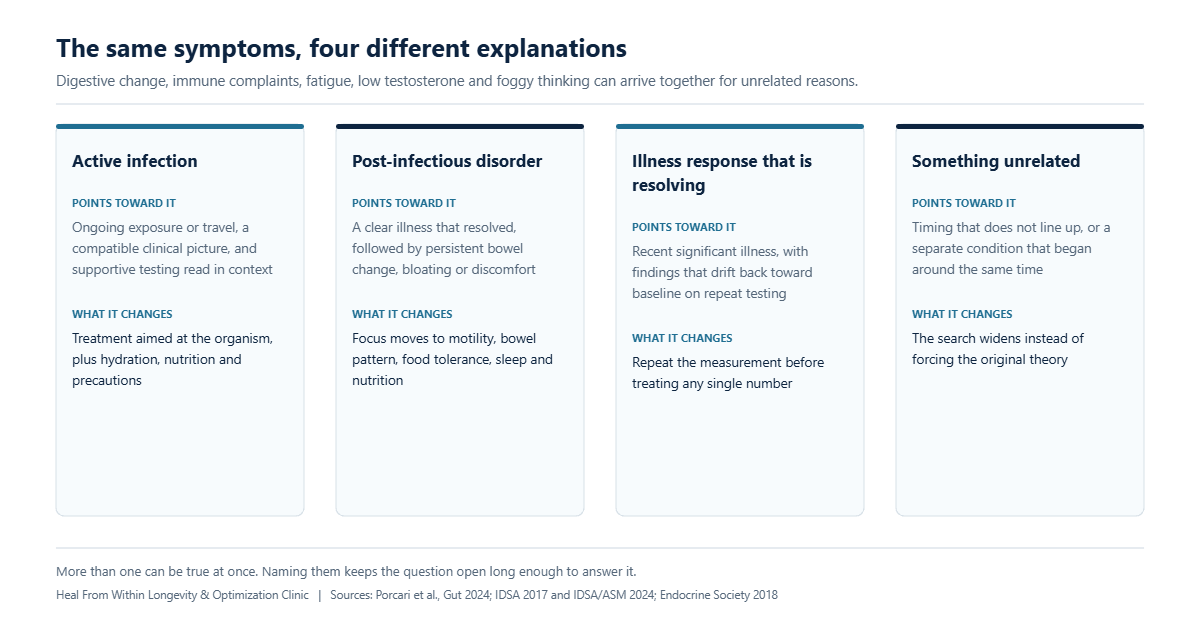
Digestive changes, immune complaints, fatigue, a low testosterone result, and foggy thinking can arrive together for very different reasons. The reason matters, because it changes what should happen next.
| Explanation | What tends to point toward it | What it changes |
|---|---|---|
| Active infection | Ongoing exposure or travel history, a compatible clinical picture, supportive testing interpreted in context | Treatment aimed at the organism, plus hydration, nutrition, and precautions |
| Post-infectious disorder | A clear illness that resolved, followed by persistent bowel pattern change, bloating, or discomfort | Focus shifts to motility, bowel pattern, food tolerance, sleep, and nutrition rather than eradication |
| Illness response that is resolving | Recent significant illness, findings that drift back toward baseline on repeat testing | Repeat measurement before treating any single number |
| Something unrelated | Timing that does not line up, findings that do not fit, or a separate condition that began around the same time | The search widens instead of forcing the original theory |
These are not always cleanly separable, and more than one can be true at once. The point of naming them is to keep the question open long enough to answer it.
Finding an organism is not the same as finding the cause
A test result does not interpret itself. Infectious Diseases Society of America guidance for infectious diarrhea cautions that molecular stool panels can detect microbial genetic material without establishing that the organism is alive or responsible for the current illness.5 The 2024 IDSA and ASM laboratory guidance makes a related point across the whole diagnostic process, setting out which tests carry value in which clinical contexts and which add little or nothing to a decision.6
This is the guardrail that keeps upstream thinking honest. A detected organism is a finding. Whether it is the explanation depends on how well it fits the symptoms, the timing, the exposures, the person, and the rest of the results. HFW says the same thing in its own patient questions: detecting an organism or an elevated marker does not by itself establish causation or a need for treatment.
Measuring well does not mean testing everything
Good measurement starts with a clinical question rather than a panel. What changed, and when? Was there travel, foodborne illness, antibiotic exposure, a hospital stay, or a long stretch of diarrhea? Are the symptoms digestive, systemic, or both? Depending on the history, useful testing may include conventional bloodwork, targeted stool testing, inflammatory and nutrient markers, hormone testing done under valid conditions, or specialist evaluation.
It can also mean deciding not to order a broad panel when the likelihood of a meaningful finding is low. A test earns its place when the result could change a decision. If a positive and a negative would lead to the same next step, the test is not answering anything.
Some symptoms should not wait for an upstream theory
Certain findings need conventional evaluation or urgent care regardless of any hypothesis about the gut: rectal bleeding or black stools, fever, unintentional weight loss, severe or worsening abdominal pain, signs of dehydration, anemia, or cognitive change that is rapidly progressive. Longevity and optimization care sits alongside emergency, primary, and specialist medicine. It does not replace any of them, and a compelling upstream story is never a reason to delay an urgent evaluation.
How HFW works through a cross-system picture
Heal From Within is a clinician-led longevity and health optimization practice in Hillsdale, New Jersey, with physician medical direction. When symptoms cross several systems at once, the sequence matters more than the number of things measured.
Discover
An advanced care clinician reviews the goal, the history, the timeline, medications, exposures, and risk, then chooses testing that could actually change the plan. That conversation is also what surfaces the red flags that belong somewhere other than here.
Correct
Correction means addressing the most defensible problem that has actually been demonstrated, using the least speculative next step available. It is not a blanket antimicrobial protocol and it is not a universal supplement stack. If the evidence points away from the gut, the plan follows the evidence.
Optimize
Hormone therapy, peptides, targeted supplements, and cognitive or performance strategies may still belong in a plan. They work better as answers to a clarified question than as substitutes for asking one. Correction comes before optimization for that reason, not out of caution for its own sake.
Monitor
Then the downstream signals get measured again. Did inflammatory markers move? Did digestion and nutrient status improve? Is testosterone still consistently low under valid testing conditions? Is thinking clearer, unchanged, or worse? Reassessment is what separates a real causal hypothesis from a persuasive story, including one we told ourselves.
The point is not to blame the gut
The body can express one upstream disturbance through several systems. It can also produce a nearly identical picture from entirely separate causes. Both of those should make everyone more careful, not more certain.
The more useful question is not which product treats low testosterone, immune symptoms, and foggy thinking at the same time. It is what evidence connects these findings in this person, and what changes if the most likely driver is corrected first. That protects patients from unnecessary treatment, protects clinicians from false certainty, and gives whatever comes later a better chance of being used for the right reason.
Frequently asked questions
Can a gut infection cause low testosterone and brain fog?
It can contribute in some people, and the link has to be demonstrated rather than assumed. Illness can suppress the male hormone axis, and systemic infection and inflammation can affect attention and cognition, but the strongest evidence for both comes from severe or critical illness rather than routine intestinal infection. In many people these findings have separate causes that happen to overlap in time.
How common are lasting symptoms after a stomach infection?
In a 2024 systematic review and meta-analysis of 47 studies and 28,170 adults, 14.5% developed post-infection irritable bowel syndrome and 12.7% developed post-infection functional dyspepsia after acute gastroenteritis, with about four times the odds of IBS and three times the odds of functional dyspepsia versus unexposed controls. Among those who developed post-infection IBS, 39.8% still had symptoms beyond five years of follow-up.
Does a positive stool test mean the organism is causing my symptoms?
No. Molecular stool panels can detect genetic material without establishing that the organism is alive or responsible for the current illness. A finding becomes an explanation only when it fits the symptoms, timing, exposures, and the rest of the evaluation, which is why detecting something is not the same as needing to treat it.
Should I treat low testosterone if my gut symptoms started first?
That is a decision for a clinician who has evaluated you, and it starts with confirming the finding. Endocrine Society guidance calls for symptoms plus consistently low testosterone, measured fasting in the morning and confirmed on a repeat test, followed by evaluation of the cause. Treating a single low value without that sequence can leave whatever produced it unaddressed.
What testing makes sense when symptoms cross several systems?
It depends on the history rather than on a fixed panel. Depending on the timeline and exposures it may include conventional bloodwork, targeted stool testing, inflammatory and nutrient markers, hormone testing under valid conditions, or specialist referral. The practical filter is whether a result could change the plan. If it could not, it is not worth ordering.
When should I see a conventional doctor instead?
Rectal bleeding or black stools, fever, unintentional weight loss, severe or worsening abdominal pain, signs of dehydration, anemia, or rapidly progressive cognitive change all need conventional evaluation or urgent care. These are not findings to work through slowly while investigating an upstream theory. If you are having a medical emergency, call 911 or go to your nearest emergency department.
Does HFW publish peptide or hormone dosing?
No. Dosing, frequency, and protocol details are individual clinical decisions that depend on the person, the product, and the monitoring plan. They belong in a consultation with a clinician who has evaluated you, not in a public article.
References
- Porcari S, Ingrosso MR, Maida M, et al. Prevalence of irritable bowel syndrome and functional dyspepsia after acute gastroenteritis: systematic review and meta-analysis. Gut. 2024;73(9):1431-1440. Systematic review and meta-analysis of 47 studies and 28,170 adults; a correction notice was published in Gut in 2025.
- Ma Y, Fan X, Han J, et al. Critical illness and sex hormones: response and impact of the hypothalamic-pituitary-gonadal axis. Ther Adv Endocrinol Metab. 2025;16:20420188251328192. Review of how the male and female hormone axis is altered in acute and critical illness.
- Bhasin S, Brito JP, Cunningham GR, et al. Testosterone Therapy in Men With Hypogonadism: An Endocrine Society Clinical Practice Guideline. J Clin Endocrinol Metab. 2018;103(5):1715-1744. The diagnostic sequence for hypogonadism, including confirmation on repeat morning fasting measurement.
- Bansal AS, Seton KA, Brooks JCW, Carding SR. Cognitive dysfunction in myalgic encephalomyelitis and chronic fatigue syndrome. Int J Mol Sci. 2025;26(5):1896. Review of how systemic infection and inflammation may affect attention and cognition.
- Shane AL, Mody RK, Crump JA, et al. 2017 Infectious Diseases Society of America Clinical Practice Guidelines for the Diagnosis and Management of Infectious Diarrhea. Clin Infect Dis. 2017;65(12):e45-e80. Professional guidance on stool testing, including the limits of molecular detection.
- Miller JM, Binnicker MJ, Campbell S, et al. Guide to Utilization of the Microbiology Laboratory for Diagnosis of Infectious Diseases: 2024 Update by IDSA and ASM. Clin Infect Dis. 2024. Which tests carry diagnostic value in which clinical contexts, and which add little.
Related reading
- Are gut microbiome tests accurate?
- Gut health and digestive dysfunction at HFW
- What are the signs of low testosterone?
- Advanced health testing: what HFW measures and why
Written by the HFW clinical team. Medically reviewed by Christina Warner, APN-C on September 10, 2026.
Testing is generally available nationwide. The exact treatment service depends on the patient’s state, clinician authorization, laboratory rules, pharmacy requirements, and the therapy involved.
This article is educational and does not provide individualized medical advice. It does not establish a clinician-patient relationship. Individual questions about your own health belong with an HFW advanced care clinician or your own physician. If you are experiencing a medical emergency, call 911 or go to your nearest emergency department.
Schedule a complimentary introductory call with an HFW advanced care clinician.